
READER SUBMISSION: More about the Dunnegan family and pottery shop
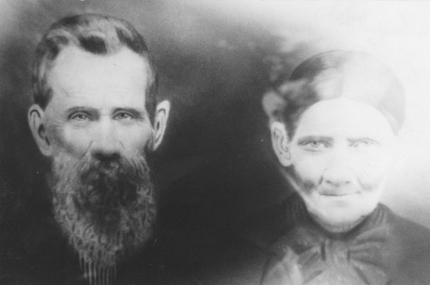
Samuel Dunnegan
I want to thank the Ozark County Times for the July 29, 2026 article on the John Lawrence family and the creation of the replica historic cabin along Highway 5, north of Gainesville. I enjoyed that article from a purely historical point of view, but also because I learned more details about who was working with my family members at the Dunnegan pottery shop.
I am a descendent of the Dunnegan family (misidentified as the “Dinnigan” family in the article) and am familiar with the Dunnegan pottery shop that Mr. Lawrence worked at.
Samuel L. Dunnegan (1826-1913), the potter, was a brother of my great-great grandfather. My mother told me many times the story of Samuel Dunnegan, who had a crooked finger that marked the pots he turned. I inherited one of those pieces from her–a small crock. The potter James Dunnegan (1870-1920) mentioned in the article was Samuel’s nephew.
In the early 1990s, my mother, my sister, and I visited a cousin, Jeff Frazier of Noble. The conversation turned to family history, and I asked Jeff if anyone still living knew the location of the Dunnegan pottery shop. Jeff said he knew where it was, and we all agreed to meet the following day to travel to the spot.
He led us to a location along the east side of Highway 5, south of the Bryant Plastics plant (that business is now named Titan Built) and north of the Lawrence cabin. Using a tall sycamore tree as a landmark, we parked and descended the steep bank of the highway, walked through a strip of timber, and crossed a small stream where the pottery shop had been strategically located. At the site, the earthen-banked groundhog kiln was in disrepair but still largely intact; the arched roof and ware bed were easily discernable. There was a ditch and berm immediately to the left of the kiln, as you faced it; I never learned their function. To the right of the kiln-approximately 25-30 feet, the horse-powered pug mill area was still visible as a welltrodden and mostly barren circle with a raised center area. The kiln area was quite heavily wooded; the mill area was less overgrown, but no plow had touched it. We picked up sacks of pottery shards and pried out a few of the green glaze-covered kiln bricks to take home as mementos. I don’t know the names of other nearby pottery shops or their locations, but the pottery shards and artifacts plowed up by Tom Hardcastle in 1960 were not from the Dunnegan shop, as the historian Cal Hogard believed, because I saw it largely intact in the early 1990s.
I visited the kiln site a few more times with other family members. Several years later, I was saddened to see the entire area had been dozed and cleared.
Mary Lou Price, Ava