
Transplant gives former city council member Renee Schmucker a second chance at life
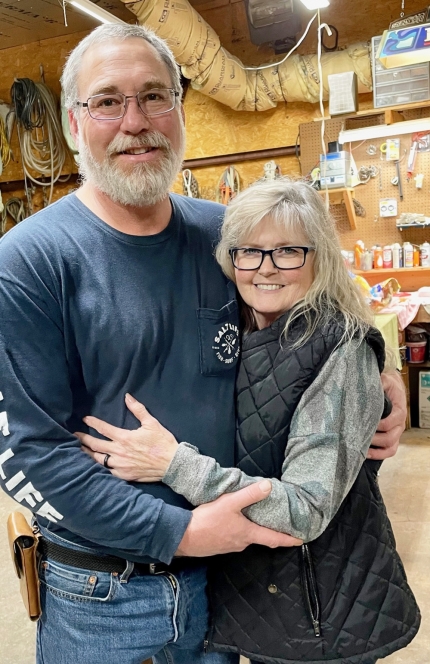
After undergoing a lung transplant on June 18, Renee Schmucker, shown here with her husband, Dan, spent a total of seven weeks in Barnes Jewish Hospital in St. Louis followed by 11 more weeks of outpatient rehab in St. Louis. Dan stayed with Renee the whole time, until his three months of family leave ran out. Then a cousin came from California to help.
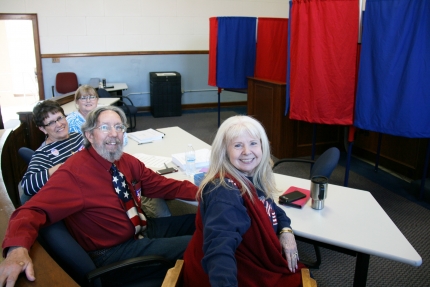
Renee Schmucker, back, served as an election judge for several elections. In this photo, taken in the November 2017 election, she and her fellow judges (from left after Renee) Lana Cockrum, Dennis Lawson and Diane White, are all wearing red, white and blue.
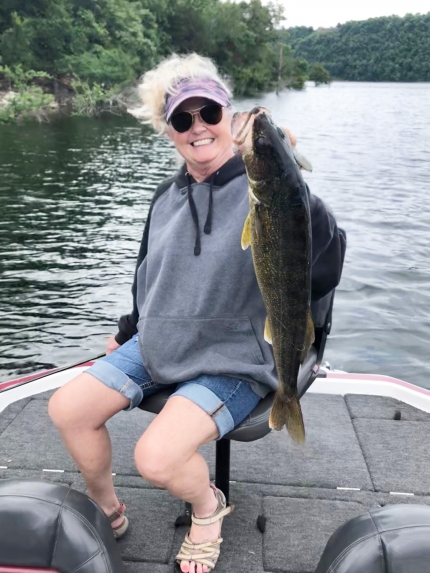
In her 40-plus years of living in Ozark County, and until her lungs developed pulmonary fibrosis, Renee and Dan have enjoyed a busy life that included favorite activities – like fishing on Bull Shoals Lake, where she caught this walleye.
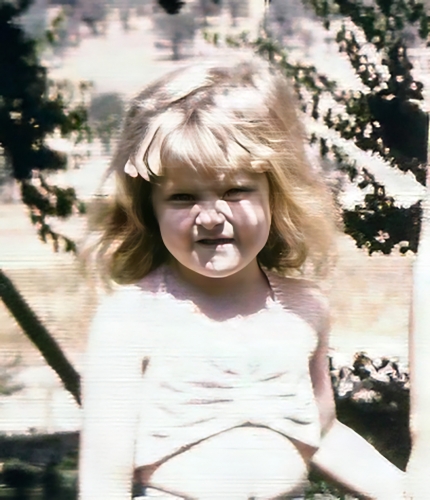
Renee, shown here at age 3, grew up in California, but both of her parents had grown up in Arkansas and stayed in touch with family there and visited every year. No one else in Renee's family developed pulmonary fibrosis.
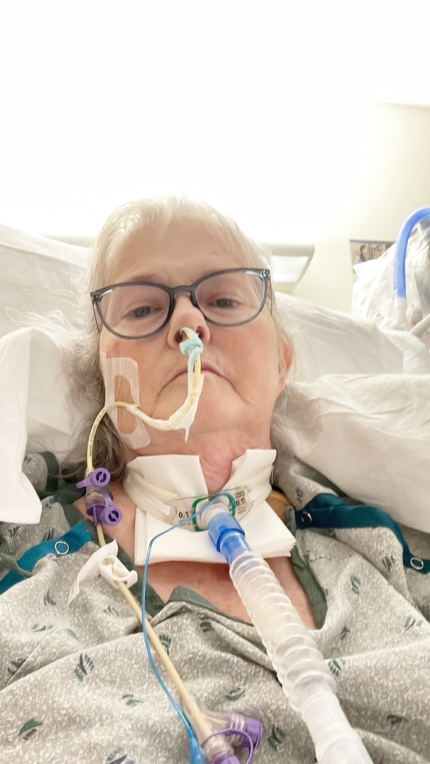
While some transplant patients can be taken off the ventilator a day or two after surgery, Renee's recovery was longer and eventually included a tracheotomy. This photo was taken a few weeks after the transplant.
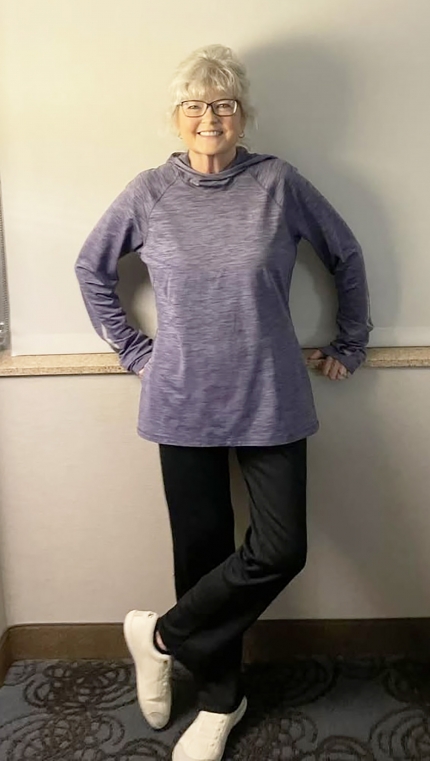
At her one-year check-up back at Barnes Hospital in St. Louis in June, Renee was delighted to get an excellent post-transplant evaluation. Her smile reflects that good news.
In 2017, former Gainesville City Council member Renee Schmucker was already having breathing problems. Then her doctor prescribed the drug Ofev, and its price really took her breath away. The medication, used to slow lung-function decline in major respiratory diseases, cost $12,500 a month.
"When they first told me, I said, 'I'm just going to have to die,'" Renee recalled recently.
She "had never had good lungs," and had endured repeated bouts of bronchitis throughout her life, beginning when she was hospitalized with it when she was a toddler. For many years, she was treated for asthma. But as an adult, her occasional breathing problems didn't slow her down. She might get a cold, virus or bronchitis, but she would recover and carry on with her busy life. Overall, she said, "I was in good health."
That continued until she was closing in on age 60.
Renee, now a longtime Gainesville resident, was born in 1955 in Calaveras County, California ("home of the Jumping Frog Jubilee," she said with a laugh). She grew up in California, raised by hard-working parents who had both grown up in the Boston Mountains of Arkansas and maintained strong family ties there. Renee's parents took their family back home each summer – "our yearly pilgrimage back to the 'holy land,'" Renee said, laughing.
She remained in California after graduating from San Andreas High School in 1973. Then, 10 years later, in 1983, she and her then-husband decided to resettle back in the Boston Mountains. "We planned to move to Arkansas but couldn't find a suitable house there and drifted north," she said. They ended up settling in Wasola two weeks before school started that year. Renee's older son, John, enrolled in fourth grade in Ava. Her younger son, Wayne, was only 3 years old.
Stunned by a diagnosis
In the 40-plus years Renee has lived in Ozark County, she has held an amazingly wide range of jobs. She worked in the office at the Emerson plant in Ava then sold advertising for the Ozark County Times. She worked as a "phone-call bill collector" and then completed training as a surgical technician and worked in that role at what is now Baxter Health Medical Center in Mountain Home, Arkansas. Later she worked with her next husband as a legal-process server and helped run a gun store and payday-loan office.
After that marriage ended, she married Dan Schmucker in 2009. Dan is manager of the White River Valley Electric Cooperative office in Gainesville. He and Renee have enjoyed a rewarding, active lifestyle together, and Renee had no real health issues, except for frequently being short of breath.
That changed in 2015, when she came down with a bad case of bronchitis and had trouble breathing. Her primary care doctor ordered a CT scan, which prompted a diagnosis of idiopathic pulmonary fibrosis. “The ‘idio’ means they can’t tell what caused it,” Renee said. “For some people, it’s congenital, but not for me.”
Stunned by the diagnosis, Renee went home and researched the disease on her computer. “I looked it up and thought, ‘Noooooooo,’” she said.
She went to different pulmonologists seeking second and third opinions. One of them, an African-American, told her, before the exam, “You can’t have that. That’s a disease of old, fat, white men. You’re not old, not fat, but you are really white.”
A serious choice
But the diagnosis didn’t change. She learned that pulmonary fibrosis usually progresses one of two ways. “Most people get it and go downhill fast,” Renee said. She’s thankful her case has played out the second way: “It progresses very slowly, and you’re pretty stable for seven to 10 years. Then you go into a quick dive,” she said, adding that she’s thankful for those years when she could continue to be productive and live a fairly normal life.
In 2017, she was evaluated at Barnes Jewish Hospital in St. Louis, where her pulmonary fibrosis was again confirmed, as was a prediction of more years of stability ahead – before the inevitable “dive” when her symptoms would worsen. Then came the first time the word “transplant” came up. Renee was told that, when her condition deteriorated, and it almost definitely would, a lung transplant would probably be needed to keep her alive.
Soon after that visit, Ofev, with its sky-high price tag, was prescribed. Renee felt tremendous relief when she learned that their health insurance, through Dan’s membership in the Brotherhood of Electrical Workers Union, covered most of the cost, and a manufacturer’s discount coupon paid the rest.
Dan and Renee live in Gainesville, and in September 2020, she was appointed to finish the term of a member who had resigned from the Gainesville Board of Aldermen (usually called the Gainesville City Council).
By then, in addition to other jobs she held, for more than a decade, Renee had also served her community as an election judge under the supervision of the Ozark County Clerk Brian Wise. In its Nov. 11, 2020, edition, the Times reprinted thoughts Renee had published on her Facebook page the previous week.
“I always wake up a little in awe on Election Day,” she wrote. “As I prepare for a long day working at the polls, I know that I am not the only one. That all over this nation other men and women are doing the same thing. Thousands have put aside everything else to be there. Not in support of a party or a candidate but to do their best to ensure that a fair election takes place. And they have been doing this thing since 1789. Thousands of feet today, marching off together to open the polls. Yes, I am in awe.”
Her words reenforced Wise’s earlier statement that election judges are “the quiet heroes of the election process.”
Renee was elected to her city council position twice and served until January 2025, after her health took that predicted “dive” in July 2024.
“I caught a virus and had a cough, and I just couldn’t get better,” she said. Her primary care doctor asked her to do a six-minute monitored walk inside the office, during which her oxygen level dropped to 82. “So he ordered me to go on oxygen,” she said.
As soon as she could get an appointment, she saw her pulmonologist, who sent her back to St. Louis for a week of testing at Barnes in December. The results put her on a transplant “watch list.”
“It wasn’t the transplant list,” she said. “They had me come back every month to watch how I was doing.”
She and Dan went back in February and then again in March, when things had deteriorated to the point that a serious choice had to be made.
“They said, ‘You can have the transplant or not. It’s your choice,’” Renee said. “But they said without the transplant my lungs had maybe two years left in them – ‘If you don’t catch a virus that takes you out next week.’”
The late-night call
Dan and her sons, John and Wayne, urged her to have the transplant. “They convinced me I needed to do it,” she said.
She let her name be put on the transplant list, and she and Dan returned to Ozark County to begin the anxious wait, knowing that the transplant team at Barnes “checked every day to see if there was a match for me,” she said.
Meanwhile, Renee stayed in touch with her sons and their families. She laughs, remembering asking her 12-year-old grandson if he understood what happens in a transplant.
“He said, sure,” Renee recalled. “He said, ‘They take you to the OR and take your old lungs out and throw them out the window. Then someone dies, and they take his lungs and throw him out the window.”
Two months after she went on the transplant list, late at night on June 15, Renee’s cell phone woke her up with the special ringtone she had set for calls coming from the transplant team.
“I knew it was them. We were asleep, but I knew it was them,” she said.
She nudged Dan awake. “It’s Barnes,” she told him.
A nurse was calling. “I didn’t know whether to call you this late or not,” the nurse said. “We have lungs that we think are a match for you.”
The nurse told Renee her transplant coordinator would call her in the morning to confirm the news. “She’ll be mad that I called you,” the nurse said, “but I love to hear the excitement in people’s voices.”
The coordinator did call later that Monday morning, but she indicated they didn’t have to rush back to St. Louis. When Renee told her she already had an appointment at Barnes the next day, Tuesday, the coordinator told her to keep the appointment at Barnes, have the usual tests, “and then we’ll admit you to the hospital and the surgery will be Wednesday morning.”
Renee wasn’t told anything about the organ donor, “and I didn’t ask,” she said. But given the timing, she assumed the donor was being kept on life support until various transplant arrangements could be finalized. Later she would receive a kind note from the man who had been married to the donor for 42 years. The note was forwarded to her by the transplant service, and no other details were provided except that the man said his wife was a “wonderful, giving woman” and he hoped the lungs worked for Renee.
At 7:30 Wednesday morning, June 18, Renee was taken into surgery. She wouldn’t know or remember anything that happened for the next three weeks.
Dan sat alone in the hospital’s transplant waiting area during her surgery. “Two or three of his friends offered to be with him,” Renee said, “but he said no. He wanted to be alone.”
‘Hellacious hallucinations’
Renee’s surgery lasted eight hours and began with a “clamshell” incision across her chest from armpit to armpit. Her ribs were broken, and her sternum was cut so that her lungs could be removed and the donated lungs could be placed.
She hadn’t asked the transplant team what her odds of survival were, but before her surgery they had assured her that, at their hospital, “they had never lost anybody ‘on the table,’” she said. “Getting through the surgery was the big thing.”
After that, the survival rate wasn’t as perfect – and her own long and difficult recovery made her family wonder sometimes if she would survive.
The frightening problems became apparent the day after the transplant surgery, when the medical team tried to remove the breathing tubes so that she was using her new lungs to room breathe, unaided. “When they did that, my blood pressure shot up, and I turned as red as an apple,” she said. “They told Dan, ‘We can’t keep doing this or she’s gonna stroke.”
Extubating was a no-go for a while longer.
Many lung-transplant patients can be extubated the day of the surgery or the day after it, and they walk out of the hospital in a week or so. Eventually, the medical team did a tracheotomy (an incision directly into the windpipe), and she spent a total of seven weeks in the hospital – four of them in intensive care unit.
Renee was kept in a coma while her body and her new lungs recovered, and she remembers almost nothing about what was happening to and around her during most of that time, including visits from friends and relatives. What she does remember, though, are the “hellacious hallucinations” she had.
One time she dreamed that nurses were putting LSD in her meds, making her see crazy displays of psychedelic colors. In her dream, “I wanted to tell someone, but I couldn’t talk,” she said.
“Dan said I was sometimes very combative and tried to pull out tubes,” Renee said. “So they made mittens out of gauze and tied my hands to the bed frame.”
The crazy dreams continued. “Once I dreamed I was curled up in a Corningware dish in a cream sauce,” she said. “I just loved it! I had been cold, and it was so warm in the sauce. It seemed perfectly normal.”
In the last hallucination she remembers, she was a yak working with a line of other yaks that stretched over the Himalayan Mountains. “As far as you could see – yaks,” she said.
When she shared her crazy dreams, her doctor laughed and said, “You and animals.”
Step by step, Renee’s health improved. She finally transferred out of ICU into a step-down unit. After she left the hospital, she and Dan remained in St. Louis so she could go back to the hospital each day for rehab. When his three months of family leave run out, a cousin came from California to stay with her and drive her to appointments.
There were some difficult setbacks. During one early medical check-up while she was still doing rehab in St. Louis, the team discovered that her body was rejecting the new lungs. “It scared me to death,” she said. She was re-hospitalized and treated with “super-high steroids” that made her feel amped-up. “I felt like I could have climbed out the window and flown away,” she said. During that hospital stay, she also had leg pain that was soon diagnosed as blood clots.
With those problems resolved, on Oct. 30, 2025, 18 weeks after her transplant, Renee came home to Ozark County.
She was still weak and had to use a walker or a wheelchair to get around. She also had to go to pulmonary rehab three times a week in Mountain Home. In the first weeks of the three-month program, she relied on friends to drive her. “But toward the end, I was able to drive myself,” she said.
The pulmonary rehab helped a lot. By the end of the three months, Renee could do 30 minutes on a treadmill or 40 minutes on the elliptical trainer. “But I was still so weak,” she said.
Working toward recovery
Since then, she’s steadily regained her strength, but her continuing recovery hasn’t been easy. She has worked for it. One part of her regimen is participating in the Open Gym program in the Physical Therapy Department at Ozarks Healthcare’s Gainesville Medical Clinic. Clients pay $110 per month, and the physical therapists design a program for each individual, who can then follow the program on their own schedule, using the department’s equipment whenever the clinic is open. Renee tries to go “a minimum of three times a week,” she said.
She also gets exercise “off the treadmill,” often walking around Gainesville’s square, sometimes stopping by City Hall to say hello to friends she worked with when she was a councilwoman.
Since June 2025, she has lost 45 pounds and has had to adjust her lifestyle to compensate for an immune system that has been “trashed” by the strong anti-rejection medications she takes – 27 pills a day.
One of the medicines prescribed for her is Tachrolemus, which carries the risk of causing kidney damage. And, sure enough, back in the spring, she started having back pain and symptoms that resembled a bladder infection. “All of a sudden I’m in stage 4 kidney failure,” she said.
That setback has meant dietary restrictions. “I have to keep my potassium and protein intake below a certain level, and they said, ‘Don’t even touch a saltshaker,’” she said.
The kidney failure diagnosis came with a heads-up about an ominous choice she might have to make. “If it keeps getting worse, eventually I’ll have to have dialysis or a kidney transplant,” Renee said, adding, “So many people who’ve had lung transplants have had kidney transplants.”
Now 70, she thought she was “too old for a transplant, but people older than me have had them,” she said. “They judge how survivable you are, and I’ve been walking and exercising,” so it might be a possibility, she said.
Except that she doesn’t think she would choose to have another transplant.
For now, that choice has moved a little further into the future. At a recent checkup with her nephrologist, she was told her condition had improved and her kidney failure is now assessed at “only” grade three.
‘Enthusiastic about the future’
Now nearly 14 months into her recovery, Renee was delighted to get an excellent post-transplant evaluation at her one-year check-up at Barnes in June. After the appointment, she posted this on her Facebook page: “The past year has been a journey of profound growth, and I’ve emerged more robust and resilient. . . . revitalized and enthusiastic about the future.”
She is “grateful to everyone who has supported me with their prayers and continues to do so,” she said in her post, knowing she was on the prayer lists of at least five churches here, including Gainesville’s First Christian Church, which she attends. “Plus people in California,” she told the Times. “I got lots of cards and letters telling me people were supporting me. It’s such a good feeling to know that,” she said.
She knows more challenges and more work lie ahead, but her experiences in the past year have given her new confidence and a heart full of gratitude - joined occasionally by a moment of survivor’s guilt. “I feel so grateful to have gotten the lungs. So grateful. But I know that means someone died,” she said.
She acknowledges that extraordinary gift with every breath she takes, and she has encouraged all her relatives and friends to agree to be organ donors. She’s especially grateful to the family of the “wonderful, giving woman” who “transformed their adversity into a life-affirming opportunity for me.” Their “selfless act of kindness,” Renee wrote, gave her a second chance at life. For that, “I’m deeply thankful.”