
Ozark County’s first modern bear harvest featured in national magazine
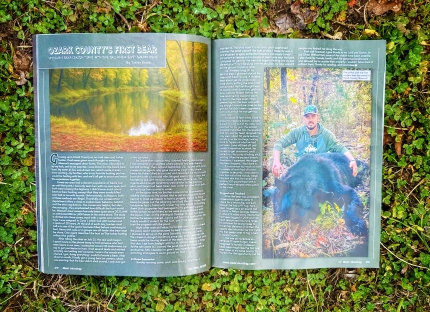
Gainesville resident Tyelor Estes is featured in this article in the January/February 2026 Bear Hunting magazine detailing his Oct. 19, 2025, experience harvesting Ozark County’s first bear in Missouri’s modern black bear season. Data from a microchip showed that the 320-pound black bear boar was three and a half years old.
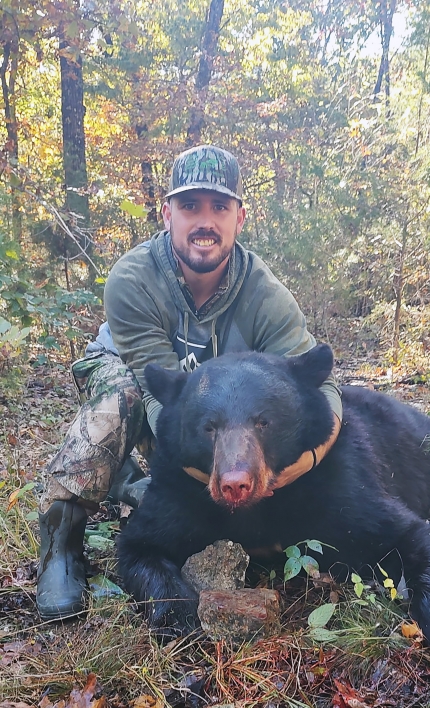
This 320-pound mature black bear boar (male) was harvested Oct. 19, 2025, by Gainesville resident Tyelor Estes. The bear was about 3.5 years old, according to a microchip tracker that had been embedded in its skin when it was a cub, lying in a den with its mother in Willow Springs.
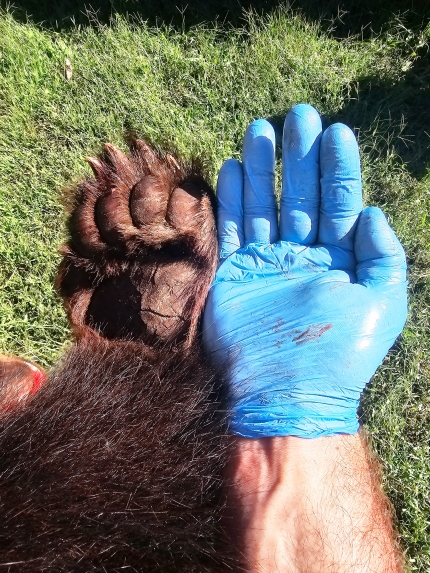
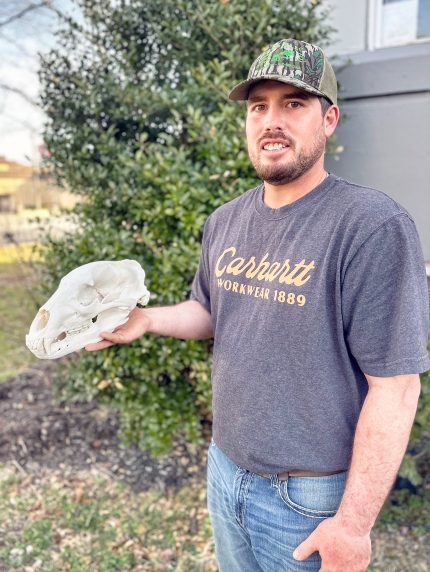
Estes shows the bear’s bleached skull.
Caught halfway up a tree with his bow still on the ground and his rifle slung over his shoulder, Tyelor Estes froze as a massive black bear stepped into view just 20 yards away.
Moments later, the Gainesville hunter would make Ozark County history.
That intense moment occurred last fall when Estes harvested the first black bear in Ozark County since Missouri’s modern bear season was established in 2021 - an achievement that has since drawn national attention, with his story now featured in Bear Hunting magazine.
Estes recently sat down with the Ozark County Times to recount the hunt, which he described as an experience of a lifetime. “It’s a memory I will cherish for the rest of my life,” he said.
Drawn for hunt; first time applying
“Growing up in Ozark County as an avid deer and turkey hunter, I had never given much thought to entering Missouri’s managed draw hunts,” Estes said, referring to the Missouri Department of Conservation’s lottery-style system that allows a limited number of hunters to
purchase permits for specific hunts.
When MDC announced the modern bear season, it utilized the lottery drawing system through an application process in which hunters can apply during a designated window each spring for a chance to purchase a permit. In its first year in 2021, 6,335 people applied. Last year, about 5,250 applied for the hunt. From that pool, MDC randomly draws a limited number of hunters to participate. It was 400 in earlier seasons and increased to 600 last year.
Despite his lack of interest in managed hunts in the past, Estes decided to toss his name into the lottery for the 2025 bear season. Much to his surprise, he was selected to hunt in Bear Management Zone 1, which encompasses most of southern Missouri, including Ozark County.
“...Not only was I drawn, but my sister-in-law [Lori Estes] was as well,” he said. “That was even more exciting because my brother [Ryelon Estes], who is my favorite hunting partner, would be hunting with her. So, we could scout and enjoy the experience together.”
Scouting land close to home
While many hunters who are drawn for the bear hunt scout out areas far from home, Estes said he was confident that Ozark County could provide a successful hunt.
“I knew our area had a decent [bear] population, but up to that point, I had only seen two bears with my own eyes - both were crossing the highway,” he said. “I didn’t know much about bears or bear hunting except that they were mostly killed over bait or ran with hounds. Unfortunately, in Missouri, both of those methods are illegal.”
Looking for information, Estes found that MDC offers a class on bear hunting and its new regulations. He was eager to sign up in order to gain insight into how he should approach his hunt in that fall. He attended the class on July 23, 2025, three months before the bear hunting season was set to open.
“The class was very helpful but also discouraging, as they repeatedly told us the hunt had a very low success rate because of strict regulations,” Estes said. “Missouri has only had a black bear season since 2021. Our population is still growing, and there are an estimated 800 to 1,000 bears statewide.
“The state is broken up into three zones with each zone having its own number of tags and its own harvest quota. Since the season opened, the quotas have never been met I would be hunting in bear zone 1 with 400 tags and a 20 bear quota.
“At the end of each day, the hunters have to call in to see if the quota has been met [for their zone] before hunting the following day. We were also prohibited from harvesting bears with cubs or in groups. It had to be a lone bear, they said.”
Estes said his key take-aways from the class were that in October, when the season is held, black bears are in hyperphagia, a period from late summer into fall when bears are insatiably hungry and eat up to 20,000 calories a day, gaining 20 to 100 percent of their body weight to prepare for hibernation. During the phase, bears are very active, foraging up to 20 hours a day.
The staff also told hunters that they’d likely be most successful if they were hunting white oak flats, but to remember that you can’t fool a bear’s nose, so remaining out of scent line was imperative. Other than that, they advised them to just get out and cover ground looking for sign a bear had been in an area.
“One agent described it as ‘turkey hunting but without the gobble,’” Estes said.
Getting advice and finding the right property to hunt
After the class was over, the real work began.
“I spent countless hours on the phone, hoping to find someone who had seen or knew that there had been bears in our area. I contacted 30 different land owners in our zone, trying to get permission to hunt their properties,” he said.
His hard work paid off, and he had a lot of leads. Then, he started scouting and setting up trail cameras on those properties. “I was in the woods as much as possible, doing everything I could to locate a bear,” Estes said.
After about a month, he finally had a photo of a young bear on his trail camera. Estes said he was thrilled but that excitement soon dissipated as he realized that the first few photos would be the only ones he’d ever get of the animal. After that one encounter, his camera photos went back to a solid lack of bears.
“At that point, I was starting to get a little discouraged. I had multiple cameras set up in areas other people had seen bears, but I wasn’t having any luck,” he said.
When the opportunity arose for Estes to speak with several conservation agents on Sept. 20, just a month before he was set to hunt, he jumped at the chance to gain new insight about how and where bears had been killed, specifically in the Ozarks area. He also wanted to verify that he could bring both a bow and a rifle hunting with him, offering him the opportunity of a choice in how he would harvest an animal if one presented itself.
Mimicking the advice he received in the MDC class, the conservation agents told him to look for acorns, dropped from oak trees - but they also said it’d be helpful if he found a water source nearby too.
The days were ticking down until opening day, and with the agents’ advice in mind, Estes began narrowing down his possible hunting spots. He knew he would only have 13 days from the time the season opened until it closed to harvest a bear, so he wanted to make sure he chose a good spot.
One particular property north of Gainesville seemed promising. “It was known to have bears for as a long as anyone could remember,” he said. “The only issue was that the adjoining property had the water - and the land owner also had a buddy with a bear tag that would be hunting there.”
Both properties had previously been owned for many years by someone Estes knew, giving him insight into the land and its history; however, the land had been sold to new owners prior to the hunt.
Because the landowner’s friend was planning to hunt the place for bears during the same season, Estes decided he should look elsewhere for his primary hunting grounds. Without many good prospects, he was heading into the season without much hope of a successful hunt.
But, two days before the season opened, Estes was surprised to get a call from the landowner. “He said his buddy wasn’t going to be able to make it in for the season, and he told me that I could go ahead and hunt the property,” he said.
All the sudden, the hunt was looking up. “It was just the break I needed,” he said.
Not a good start on opening day
It was hard to keep his mind on work, but he got through his day Friday, excited that the next morning, Saturday, Oct. 18, was when the 2025 Missouri bear season would officially open.
“Immediately after work, my brother and I went to the property and checked out the pond. There were bear tracks of all sizes around the bank,” Estes said. “That was a good sign. With that much bear sign, I figured all I needed to do was set up Saturday morning, and surely a bear would come by to get a drink.”
But, as often is the case, Mother Nature had other plans. Estes said that Ozark County had been experiencing a drought for the majority of the time between the July 23 MDC class he took and opening day of bear season. Because of the extended hot, dry weather, he hadn’t had the opportunity to analyze how weather patterns could affect bear movement. But, prepared or not, the weather man forecasted that a storm front was set to roll through the area Saturday afternoon.
“I didn’t recall the conservation agents or the instructors in the class mentioning anything about weather,” Estes said. “So, I just assumed that the bears would move a lot before the storm front hit. With everything I knew at that point, I thought Saturday morning was going to be a slam dunk.”
That was not the case.
Estes said he sat near the pond bank for eight hours, from before the sun rose until about 3 p.m., and there was no trace of a bear. Then the storm rolled through, bringing much needed rain to the area but further challenging Estes’s hunt.
“I was a little worried that the pond wouldn’t be much use after all the rain from the storm,” be said. “But, I decided I’d give the pond another shot on Sunday before I started covering as much ground as possible on foot in hopes of coming across another one,” he said.
The perfect opportunity came at a very inopportune time
Then, Sunday morning seemed cursed from the beginning.
“I was getting around later than I wanted to that morning, and the wind just wasn’t in my favor to hunt that spot,” he said, remembering the MDC instructor’s advice that you can’t fool a bear’s nose. “As I was walking toward the pond, I kept debating if I was making the right choice to hunt in that location again.”
But, already committed and without another good spot as an alternative, he kept the course. When he reached the pond, he sprayed a bear attractant on some of the leaves and tree trunks surrounding the pond.
Then he walked to a nearby tree in order to get into position for the hunt. He was using a “tree saddle,” a harness-type system that allows a hunter to hang from the tree rather than sit in a traditional stand. But before installing the harness, he would need to climb up the tree to his desired height, well above any sight line for animals who may be walking by.
In preparation to start tying on the temporary steps he uses to climb the tree, Estes reworked his hunting gear, moving it to his back and slung his rifle over his shoulder. Then he began the process of climbing, securing the steps up the tree as he went. He left his bow at the base of the tree, connected with a rope that he would use to pull it up once he was set in position in the tree saddle.
“As I was finishing tying off my second step, I looked around the tree and saw a massive bear standing 20 yards away, right where I sprayed my attractant,” Estes said. “He was testing the wind and starting to smell around the area I had sprayed.”
Halfway up the tree with no way to utilize his rifle and with his bow lying on the ground under him, Estes knew he was in a bad place. Heart beating rapidly, he decided to try to climb down, grab his bow from the base of the tree as quietly as he possibly could and attempt to get in a position to get a shot.
The one thing he had going for him was that the tree was blocking the bear’s view from where he was hanging in the precarious spot. “I was trying desperately to avoid reaching around the tree [to help myself climb to the ground], but I was also really struggling to get down.”
Placing one foot in a rope aider, a contraption that was attached to the bottom of his steps, Estes steadied himself and peeked around the tree to assess the situation. There, he was met with quite a surprise.
“The bear was coming right for me with his nose on the ground. I don’t believe he had an aggressive intent, but he was close enough that I knew it was time to make my presence known,” he said. “I jerked my foot out of the aider and pulled my gun off my shoulder and pointed it at him.”
The sudden movement spooked the bear, who ran away from the commotion. With a little distance between them, Estes was relieved he hadn’t been the subject of a bear attack, but he couldn’t help feeling disappointed too.
“My heart dropped as he ran away. He ran about 50 yards and stood up on his hind legs, looking back to try and figure out what he saw,” Estes said.
“I still had my lineman rope around the tree, so I couldn’t get in position to shoot where he was standing. He started to circle back downwind, and I knew he was going to get in a position to get a good sniff and figure out what I was,” he said. “So, I rested my gun off my climbing stick and got [my sights] on him, waiting for him to stop so I could make a clean shot. When he got directly downwind, I knew it was now or never. I took a deep breath and squeezed the trigger.”
The bear went down.
“I couldn’t believe it. I did it,” he said. “It was such an unreal moment. I’ll never forget it.”
A microchip that provided a history
Estes was able to pull the harvested bear out of the wooded area, where he could skin and weigh the animal.
“I couldn’t believe how big he really was. A whopping 320 pound boar with a perfect heart-shaped white patch on his chest,” he said.
He called the MDC line to properly report and tag the bear and tell officials that he’d had a successful harvest. He began skinning and processing the animal, and local MDC agents were dispatched to the area.
They wanted to check to see if the harvested bear had a Passive Integrated Transponder (PIT) tag. The small rice-sized microchip is implanted under the skin of bears that are trapped by conservation staff, which allows biologists to track the animal throughout its life cycle, providing accurate information on that specific bear to aid in research and further understanding the species and its population.
“He did, in fact, have one,” Estes said. “He was tagged in 2022 in Willow Springs, making him 3.5 years old. He was a cub, still in the den with his mother, at the time he was tagged. His mother had been trapped multiple times over the years.”
Willow Springs is about 31 miles, as the crow flies, from where Estes harvested the bear. “It’s not uncommon for young males to travel that distance or even further in some cases,” he said. The agents shared the history and told him he was the first person to ever tag a bear in Ozark County. Estes said it is an honor to hold that title.
“It was an incredible experience to say the very least. I never really thought I would harvest a Missouri black bear, much less be the first one to do so in the county I was born and raised in. It’s a memory I will cherish for the rest of my life.”