
Gainesville business owner asks city council to allow UTVs on city streets
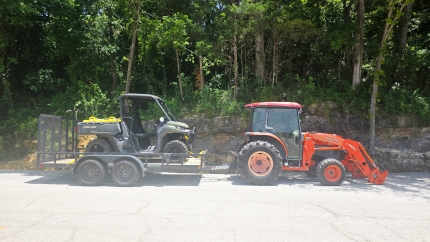
This photo was recently taken of Mike Gardner’s side-by-side, which has to be loaded on a trailer and pulled by a tractor, for the couple miles it takes to get from The Antler Pizza & Package to The Harlin House or his other nearby businesses due to a city ordinance that prevents UTVs to operate on city streets. He is now asking the city council to consider revising that ordinance to allow UTVs and golf carts to operate on city streets.
A proposal that local business owner Mike Gardner presented at the July 21 Gainesville City Council meeting has sparked a lively discussion across the Ozark County.
Gardner appeared before the city council that night to ask members to reconsider the city’s longstanding prohibition on golf carts, utility task vehicles (UTVs), side by sides and similar off-road vehicles operating on city streets.
To support his request, he presented council members with two lengthy packets of information. One contained a sample ordinance he drafted with assistance from the Ozark County Sheriff’s Department, modeled after ordinances adopted in other Missouri communities that allow those types of vehicles on city streets.
The second outlined what he believes are the economic, tourism and community benefits of allowing golf carts and UTVs to operate on designated city streets under a regulated permit system.
“We often hear our elected officials say they want to see the town grow, attract visitors, support local businesses and create a stronger future for our community. Those are worthy goals, but growth requires more than words,” Gardner said. “It requires a willingness to consider practical ideas, listen to the public and take reasonable action.”
The current ordinance
City officials say that the ordinance Gardner hopes to amend has been in place since 2011; however, it hasn’t been strongly enforced until recently.
It prohibits the operation of golf carts, all-terrain vehicles, utility vehicles and other off-road vehicles on city streets, alleys and other public property unless specifically authorized by law. That ordinance governs city-maintained streets and public property within Gainesville.
To be clear, state highways are governed by Missouri law and MoDOT regulations, while Ozark County separately regulates the operation of permitted utility vehicles on county-maintained roads–even if those roadways are in the city limits.
Support of the proposal
Gardner’s proposal argues that allowing golf carts and UTVs on designated city streets could provide economic benefits for businesses throughout Gainesville by creating a convenient way for residents and visitors to move around town.
“As a business owner operating multiple locations within the city, employees could safely travel between businesses without moving larger vehicles, reducing fuel costs, parking congestion and unnecessary wear on company vehicles,” Gardner wrote in his request.
“Business owners could also transport supplies, make quick deliveries and respond more efficiently to customer needs.”
He said the vehicles could encourage customers to visit more local businesses within Gainesville during a single trip rather than shopping or doing business in outside towns because they offer an affordable and practical option for short-distance travel. “Someone who drives a golf cart downtown may stop for lunch, shop at local stores, purchase fuel, visit the pharmacy and support several businesses instead of making only one stop,” he wrote. Gardner said those additional visits could help keep more sales tax revenue within the city limits.
“For senior citizens, individuals with limited mobility and families, these vehicles offer a comfortable alternative for short trips without needing to drive a full-size automobile,” he said.
For visitors, Gardner believes golf carts and side-by-side UTVs could become a tool to support Gainesville’s tourism industry by encouraging people to stay longer, visit more businesses, eat at local restaurants, attend festivals and return for future visits.
He said that he has multiple customers who drive their side by sides on county roads to The Antler restaurant to eat, one couple drives theirs from as far away as Midway, Arkansas.
He also said the vehicles could strengthen community connections by making it easier for neighbors to interact and participate in local gatherings. “Allowing golf carts and UTVs on designated city streets is a practical, low-cost improvement that benefits everyone,” Gardner wrote. “Residents gain convenient transportation. Businesses gain increased customer traffic and operational efficiency. Visitors enjoy easier access to local attractions. The City benefits from increased economic activity, stronger community engagement and additional local revenue.
“As a business owner with multiple locations in Gainesville, I believe this ordinance would make day-to-day operations more efficient while encouraging residents and visitors to support all of our local businesses,” he added. “This proposal is not solely for the benefit of one business, it is an investment in the continued growth, accessibility and vitality of our entire community.”
Day-to-day impact
Gardner told council members during the meeting that the ordinance has become increasingly burdensome for his businesses, which operate from multiple different properties inside the city limits of Gainesville. Those businesses include The Antler Pizza & Package, The Antler Motel, The Harlin House event center, The Antler Cottage (a short term rental cabin) and, most recently, Top Dog Fitness Center. Because he cannot legally drive a side-by-side between locations, he says routine maintenance has become unnecessarily expensive and time consuming.
“I have to load my side-by-side on the trailer with the sprayer and hook it to the tractor and then haul the side-by-side around by the tractor to spray,” Gardner said. “We have seven properties in town, so it’s really a challenge. Each day, I probably spend an extra $200 hiring people to go hook the tractor up from the farm and bring it down here. Then load it up, put the sprayer on and go do maintenance.”
Safety concerns
His wife, Heather Gardner, was also in attendance at the meeting and emphasized that while the issue affects their businesses, the proposal was never intended to benefit only the Gardners. “The ordinance is for the entire town,” she said. “We think it would benefit a lot of people, not us specifically. We would like it to benefit everyone.”
She said one of the biggest concerns people have expressed to her about the proposal is the potential for injury and risk of safety, but she argued that the city’s current ordinance prevents any legal operation, even by responsible drivers.
“Right now, the ordinance just blocks everyone,” she said. “There’s no one who has any ability to use them, even in a safe fashion. [We are asking] to create some kind of permit system that would allow us to use it in a safe fashion...”
Gardner’s written proposal also touches on that topic.
“Safety concerns should always be taken seriously. However, concerns should lead to sensible regulations, not an automatic rejection of the entire idea,” Gardner argued.
“Missouri law specifically gives municipalities the authority to allow golf carts and qualifying utility vehicles on streets under their jurisdiction. Gainesville is not being asked to ignore state law, turn its streets into recreational trails or allow unregulated vehicles to operate wherever they please. The city is being asked to use the authority already provided by Missouri law to create a responsible local ordinance,” he said.
Gardner proposed that a new city ordinance could require drivers to have a valid driver’s license, proof of liability insurance, an annual city permit and identification decal, functional headlights, taillights, brake lights and adequate brakes, rearview mirrors and required safety markings, seat belts and roll-over protection where applicable, be compliant with all traffic laws, operate only on approved city streets, adhere to restrictions on state highways except at approved crossings and reasonable hours of operation, respect speed limits and be prepared for penalties for careless, reckless or impaired operation.
“These are not unusual or unrealistic requirements,” he said. “Many Missouri cities including Ava already have an application process for golf carts and UTVs that requires driver’s-license information, proof of insurance, a city decal and an annual fee. Its application also reminds operators that they must follow city ordinances and state laws. Gainesville can do the same.
“No type of transportation is completely without risk. Cars, trucks, motorcycles, bicycles and pedestrians all share public streets under established rules. The purpose of an ordinance is to manage risk by deciding who may operate a vehicle, where it may be operated and what safety equipment must be installed.
“Saying that golf carts and UTVs were not designed primarily for paved roads does not end the discussion. It simply identifies the reason Gainesville should limit their use to appropriate streets, licensed drivers, safe speeds and properly equipped vehicles.
“A regulated system is safer than uncertainty. Clear rules give operators guidance and give law enforcement a definite standard to enforce. A blanket prohibition does not create a thoughtful transportation policy; it simply prevents responsible residents from using an option that other communities have successfully regulated,” Gardner’s proposal reads.
Gardner also noted that organizers of this year’s Hootin an Hollarin festival are requesting special permission to use side-by-sides during the Sept. 17-19 event to assist with setup, transportation and cleanup.
A resident in support of a change
After Gardner made his request, local resident Ray Grisham, who owns Crossroads Drips & Dips in town and other businesses in the area, addressed the council in support of Gardner’s proposal. “I’m backing Mike’s ordinance,” Grisham said. “Just to the benefits of people coming into town with their side-by-sides. If you’ll notice in the paper, Theodosia has a parade for theirs. They have people coming in, which brings revenue in. I think we all agree that we need all the revenue we can get.” Grisham said, saying he agreed that the vehicles could make Gainesville a more attractive destination while benefiting local businesses.
City council members discuss
Much of the discussion from the city council members centered on advice from the city attorney and city prosecutor and whether the city could realistically enforce a permit system.
Councilwoman Treva Warrick said City Attorney Jessica Blackburn had previously recommended leaving the existing ordinance unchanged. When asked about that recommendation after the meeting, a city official told the Times that Blackburn reviewed the ordinance after questions were raised about whether it contained any legal loopholes. The official said Blackburn concluded the ordinance did not require changes, and, because the council had not expressed interest in revising it, advised leaving it as written.
Councilwoman Lana Bushong, however, said City Prosecuting Attorney James Mucklestone had a different perspective on the ordinance. “I think maybe if she’d hear him out, she might change her mind,” Bushong said.
Mucklestone told the council that, rather than creating additional problems, a permit system could actually provide clearer rules and stronger enforcement than the city’s current blanket prohibition. Earlier that day, he said, a local business owner had expressed concerns about underage drivers operating side-by-sides through an alley beside the business. “I said, ‘Now there’s no enforcement. There’s an ordinance that prohibits [all of] them, and that’s what you get.”
He suggested a revised ordinance could require operators to have a driver’s license, maintain insurance and display a permit decal, while giving the city authority to revoke permits from individuals who repeatedly violate the rules. “One of the suggestions that I floated out there... is that we identify bad behavior on-site and revoke the permit,” he said.
When Warrick questioned who would actually enforce those permits, Mucklestone suggested responsibility could be shared between city officials and the Ozark County Sheriff’s Office, with permit holders bearing the burden of challenging any revocation in court.
Enforcing a new ordinance
Mayor Reich remained unconvinced, saying her biggest concern was that existing traffic laws are already seldom enforced within the city. “We don’t have anyone right now who enforces our traffic ordinances,” Reich said. She said she regularly sees motorists run stop signs, speed through town and ignore traffic laws without being stopped. She said she rarely sees deputies spend time within the city limits conducting traffic control. She said, from her experience, she thinks the deputies just “don’t do traffic.”
In recent years, the City of Gainesville has held a contract with the Ozark County Sheriff’s Department to provide law enforcement of city ordinances within the city limits for a fee of just over $50,000 per year. Under the contract, the sheriff’s department is responsible for enforcing the ordinances rather than the city employing its own city police officer or police department, as it had many years ago. A similar contract is also now in place with the Village of Theodosia.
Because of what she feels is a lack of traffic enforcement, the mayor questioned whether adding another ordinance would accomplish anything. “I don’t want them running up and down my street,” Reich said. “Most people have cars or pickups that they drive anyway. So what’s the purpose for running around in an ATV? They weren’t meant for city streets. They were meant for off-roading or recreation.”
Mucklestone responded that he had already spoken with a deputy about the city’s ordinance and believed deputies were prepared to enforce either the existing prohibition or a future permit system if the council chose to adopt one. He also offered to meet with sheriff’s officials to discuss enforcement procedures.
Employing a city enforcement officer?
Muckelstone also floated the idea that permit fees could eventually help fund a dedicated enforcement officer hired and employed by the City of Gainesville.
Neither Reich nor Warrick believed permit sales would generate enough revenue to make that feasible.
“I don’t think we’re going to sell enough permits [to pay an officer],” Warrick said. “We’re not going to be able to enforce these permits. I’m not going to be driving around looking for [people who are violating the ordinance].”
She also expressed concern that allowing some permitted UTVs and golf carts could create confusion, leading others to assume all golf carts and UTVs were legal to operate on city streets, whether the driver held a valid permit or not.
Before the discussion concluded, Warrick said she intended to review Gardner’s proposal in greater detail but wanted additional conversations with the sheriff’s office before considering any changes. “I think we need to have a conversation between the sheriff and the city council,” she said.
“My thing is, I’ve been told our city attorney does not suggest [revising] it. I’ve looked at other cities. The only one local is Ava that sells a permit. I don’t see any of the other cities that I’ve looked at that even allow them at all,” she said. “I travel quite a bit, and I don’t see them on city streets, and in reading [articles about the use of those vehicles in other areas], I understand why.”
Mucklestone said he also planned to speak with officials in neighboring communities, such as Theodosia or Ava, that already allow the vehicles to operate on city streets in order to learn more about their experiences.
Following the discussion, the council took no action, leaving the city’s 2011 prohibition unchanged while members continue to consider Gardner’s proposal.
What are other agencies doing?
While Gainesville currently prohibits golf carts, UTVs, ATVs and other off-road vehicles on city streets, different rules apply depending on who owns the roadway. It’s worth noting that not all roadways within the Gainesville city limits are city streets. There are also state highways (usually identified with letters or numbers such as Highway 181 or J Highway) and roads maintained by the county (usually named County Road #).
Other cities: Under Missouri law, municipalities have the authority to adopt ordinances allowing golf carts and qualifying utility vehicles to operate on city streets under conditions set by the city. Without a city ordinance specifically authorizing them, those vehicles are generally prohibited on municipal streets. Cities that do allow them in some format include: Republic, Lebanon, Ava, Branson West, Lake Ozark, Camdenton and Overland, among several others in the state.
Missouri state highways: The Missouri Department of Transportation generally prohibits golf carts and UTVs from operating on state-maintained highways. However, state law allows municipalities to authorize golf carts to cross certain state highways at designated intersections, and utility vehicles may be operated on highways only in limited situations specifically authorized by state law.
Ozark County: On county roads within Ozark County, it’s a different story. For nearly 30 years, the county has sold permits for ATV use on its county-maintained roads. To do so legally, operators must obtain an annual permit from the Ozark County Clerk’s Office and follow laws the state has put in place, which mostly involve safety equipment requirements. County Clerk Brian Wise told the Times that the county sells “several, several dozen” permits each year, and the permits are valid as long as the owner has that particular vehicle.
If Gainesville were to adopt an ordinance similar to those in communities like Ava, residents would still need to comply with both state law and any city-specific permit requirements before operating the vehicles on city streets.
For more information on this or other city ordinances, call Gainesville City Hall at 417-679-4858, or stop in their office, located on the north side of the Gainesville square.