
Bakersfield school makes more than $200,000 in cuts amid recent state funding concerns
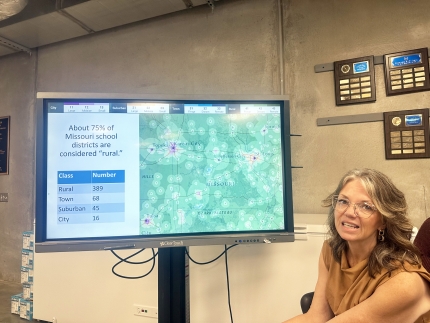
Bakersfield School Superintendent Dr. Amy Padgett is pictured here showing a PowerPoint presentation about the effects that recent legislation has had on rural school districts including the five in Ozark County: Bakersfield, Dora, Gainesville, Lutie and Thornfield.
Bakersfield School District Superintendent Dr. Amy Padgett has had enough. Bakersfield had already cut more than $200,000 from its current-year budget in response to rising costs, changing state requirements and inadequate state support for rural public schools. Then, earlier this month, Padgett was stunned to see the State Board of Education make two decisions that, in her opinion, demonstrate its lack of support for the students they’ve been charged with representing.
Realizing what this situation will mean for Bakersfield and other rural schools, Padgett is speaking out. She outlined what the cuts will do and shared broader concerns about Missouri’s school-funding system during a recent interview with the Times that focused on the financial challenges facing Bakersfield and other rural districts across the state.
‘It goes against all logic’
The State Board’s first shocking decision was to approve an “A to F” grading system for school districts without clearly defining how the grades are to be calculated. In other words, the new system includes what Padgett calls “undefined criteria” with “no targets, or even guardrails, to tell schools what constitutes their being on track to proficiency.” She compared it to having a student take a test over an undisclosed topic and then the teacher decides what constitutes a correct or incorrect response.
“It goes against all logic,” she said. “When teaching students, we always begin with the end in mind. Step one is to determine what we want kids to know and be able to do; that sets the standard or defines the correct answer. Then we teach them, using strategies that help them learn the material and complete the targeted tasks.”
In contrast, the State Board’s new system gives schools a grade for their performance on . . . well, it’s not clear. The criteria are not specifically identified. “That shows a lack of understanding of the very basics of teaching and learning,” Padgett said. “Yet they want to grade entire schools this way. It is absolutely insane.”
In addition to these new unidentified criteria, the new A to F program duplicates many specific evaluation criteria that are already covered in existing accountability programs. For example, the new system includes four criteria that were already covered in Missouri School Improvement Program (MSIP) reviews and Annual Performance Reports (APR). MSIP determines how schools are accredited, and the APR is another mechanism for evaluating schools.
Both of these programs are publicly released and take a holistic approach to evaluating schools considering academic performance, attendance, climate and culture, college and career readiness, governance and a plethora of other categories, Padgett said. But now this new group of undefined criteria has been added.
The result will be that the new A to F accountability system, which was mandated by Governor Kehoe’s executive order this past summer, will assign inaccurate grades to schools that will not indicate how they are actually doing, Padgett said.
Rural schools impacted hardest
The second decision that directly impacts schools – and frustrates rural school superintendents like Padgett – is about funding. The surprise came when the State Board of Education did not take its own funding recommendation to the legislature – and as a result school funding falls far short of what is constitutionally required.
Public school funding works like this (or is supposed to): The Missouri Constitution requires that at least 25% of state revenue, as defined by constitutional provision, be set aside annually for the support of free public schools. The Missouri Supreme Court has addressed that requirement in school-funding litigation and has held that the constitutional provision establishes a minimum state-revenue allocation.
The Missouri Department of Elementary and Secondary Education (DESE), which is overseen by the State Board of Education, is tasked with implementing the “foundation formula” that allocates state money to schools. DESE calculates the foundation formula and tells the State Board how much money is needed for the next school year. This is the same formula that was signed into law over 20 years ago.
But at the State Board’s September meeting, the board did not accept its own DESE’s formula calculation.
“To my knowledge, this is the first time this has ever happened,” Padgett said. “The State Board’s line of thinking was: The state doesn’t have the money anyway, so why ask?
State education funding currently represents only 16% of the state budget, compared with substantially higher levels in previous decades, Padgett said. Next year, state funding for schools will be $300 million short. “This is in addition to the $190 million it is short this year,” Padgett said. “That means a total of $490 million in tax dollars – close to half a billion dollars – won’t be going to Missouri public schools next year.”
“They are not even meeting state statute right now with the funding level well under 25%. Why not ask our state legislature to do what it is legally mandated to do? Passing the burden to local taxpayers who are already paying state taxes is wrong,” she said.
About 75% of the schools in Missouri are considered rural. So this funding shortfall affects rural schools hardest. To Padgett, it “goes to show what the overall attitude toward rural education is from our state government – and not only rural education but education in general.”
Top rankings despite poor funding
Of the more than 500 public school districts in Missouri, only 16 are categorized as “city” school districts, Padgett said. “Yet most of our state policies are geared toward those 16 city districts.”
More than 200,000 rural students attend PK-12 schools where graduation rates are among the highest in the nation. Missouri’s rural schools are ranked in the top 12 for national education outcomes, according to a nationwide peer-edited and reviewed study by the National Rural Education Association. “So, we’re getting more bang for our buck in rural education, but Missouri state funding is among the worst in rural schools,” Padgett said. “Missouri’s education policies toward rural schools rank number two in the nation for being the worst.”
One issue involves the state’s reliance on local property-tax revenue to support public education.
Padgett argues that the decline in state funding places greater pressure on local taxpayers, particularly in rural communities with smaller property-tax bases.
A 2025-26 report from the National Rural Education Association confirms that Missouri is heavily dependent on local funding for rural schools and that the state provides about 71 cents in state revenue for every $1 raised locally.
For rural districts, Padgett said, differences in property wealth can make it more difficult to generate the same amount of local revenue available to districts with higher-valued property.
The impact on rural communities when public tax dollars go to private schools
Padgett also raised concerns about Missouri’s Mo Scholars program, which provides tax credits that support educational expenses outside traditional public schools.
“We hear ‘choice, choice, choice. People want choice.’ I understand that, and we, as public school administrators, have advocated to our legislatures. We say, ‘If you are wanting choice, we can work that out among public schools,’” she said. “For example, if I have a Bakersfield student who wants to play football at West Plains, I’m not going to hold them back. If West Plains has a student who wants a smaller setting, our system might be a better fit for them. We can work with that because we all have our own niche, so to speak, in public education. We already have the buildings and the people employed. So why do public dollars need to go to fund private schools at the expense of rural education?”
Padgett argued that directing tax benefits toward private and online educational options reduces resources available to traditional public schools, particularly in rural communities. She also cited figures indicating that nearly 80% of the program’s funds go to the St. Louis area.
“About a month ago, I got a letter in the mail saying that we were not going to get preschool funding this year. This is where the rubber hits the road in these in rural schools: Gov. Mike Kehoe added $10 million for the St. Louis private schools, basically, at a cost of our preschool,” Padgett said. “When I was explaining this to our parents, one of them said, ‘So my kid is not getting a preschool class, but my tax dollars are going to fund a St. Louis kid’s private education.’ She is exactly right.
“And what happens to a rural community when the school disappears? That community dries up,” Padgett said. “In most of our rural communities, the school is going to be the number one employer. Schools in rural communities are the identity of the community. Think about it: as an adult, whenever you reference anything in your memory from your growing-up years, it usually has to do with school. ‘Oh, I went to school with them. Oh, we saw this on our eighth grade trip.’ Our memories and frame of reference – where you came from, your deep roots, your sense of belonging – are tied to school. That’s why our rural schools are integral to the fabric of our nation.”
Growing compliance requirements
Another concern raised by Padgett is the increasing number of requirements districts must meet through Missouri’s school accountability system. “The state is making all these new mandates for us. They have changed the superintendent’s job for sure,” she said. “The days of superintendents being able to visit classrooms, read to kids, are fewer and fewer because of all the stuff we are required to do,” she said.
The Missouri School Improvement Program, or MSIP, is the state’s mechanism for reviewing and accrediting public school districts. The Missouri Department of Elementary and Secondary Education says MSIP includes standards and indicators covering student outcomes and continuous improvement.
Padgett said the number of mandated compliance items has increased dramatically – from 37 in 2017 to 125 last year.
Difficult cuts in Bakersfield programs
Responding to the cuts, the Bakersfield district is eliminating one teaching position, one administrative position and one bus route, discontinuing funding for the golf and cross country programs as well as the E-sports technology program, and removing district funding for dual-credit classes. “That one [the dual-credit classes] was particularly difficult for me because I know that program, which lets high school students earn college credit, is an opportunity that some kids really can’t afford to pay on their own and then wait to get reimbursed,” Padgett said.
One exception to the eliminated programs came when golf coach Micheal Mahan was able to get enough private donations to continue the golf program through this year.
The popular welding and building trades program also has been reduced to a half-time teaching position. “I hated to see that happen, because that is such a needed thing,” Padgett said. “However, we do still have the option at VoTech.”
Other savings include eliminating the Hudl live-streaming system in the gym and reducing athletic travel by requiring each sports category to exclude one of its farthest trips, Padgett said.
School clubs also are now responsible for raising their own money to cover the costs of activities and trips.
Transportation costs are being controlled in part through the purchase of used buses and the use of smaller vehicles, including minivans obtained through state surplus property, Padgett said.
Career Ladder preserved
One of the district’s major concerns was protecting its Career Ladder program, which provides additional compensation to teachers for approved extra duties. Padgett said about 90% of Bakersfield teachers participate in the program, making it an important source of additional compensation for the district’s staff.
The district initially considered eliminating the program as part of its budget reductions. Instead, officials found other ways to meet the state-required 40% local match.
Those measures included a voluntary pay reduction by a staff member, grant funding, private donations and the reallocation of money that otherwise would have been used for tutoring pay.
‘We must elect officials who will act on our behalf’
Padgett said school districts’ financial challenges extend beyond individual programs and affect the ability of rural schools to provide opportunities for students. Programs such as vocational education, dual credit, athletics and extracurricular activities can play an important role in preparing students for life after high school and in maintaining the vitality of small communities.
“As fund balances fall due to less state funding, local taxpayers are picking up the slack – or students are losing opportunities. This is not right,” Padgett said. “Education is constitutionally a function of the state. Right now, we’re not even meeting our constitutional requirement of 25% of the state budget allocated to education. At last check, we are at 16% of the state budget. It’s not right that the wealthy are transferring the burden for education to local taxpayers.
“We cannot allow our public schools to become a victim of campaign contributions by the rich at the expense of the great equalizer that our public schools have always been. Public schools are not perfect. I’ve spent my career in public education, and we have a lot that we can improve on. However, there is no other place where kids from all walks of life must learn to co-exist, learn from each other, learn to respect each other and work together.
“This sense of community is what is at risk. In addition, the rural communities themselves are at risk. When rural schools close, those rural communities dry up. Roots, connections and a sense of shared belonging in a community are worth saving, and it all starts with funding our rural public schools,” she said.
Padgett, who recently announced that she will retire at the end of this school year, encouraged community members to pay attention to how state legislators vote on education issues and to communicate with their elected representatives about the needs of rural schools. “We have to stop the diversion of taxpayer dollars from public to private, because that hurts rural schools more than anything,” Padgett said. “We must elect officials who will act on our behalf, not the ones who are working against rural education. What does their voting record show?
HOW OTHER LOCAL DISTRICTS ARE AFFECTED
Gainesville School District
By Gainesville Superintendent Justin Gilmore
jgilmore@gainesville.k12.mo.us
Last year, the Gainesville School District received approximately $190,000 less than what the district should have received based on the legislatively approved State Adequacy Target, which mandates that 25 percent of state revenue is to be used to support public schools. For a district of approximately 650 students, $190,000 is significant considering our expenses for teachers and staff salaries, transportation, instructional programs, technology and opportunities for our students.
The State Adequacy Target is intended to represent the cost of providing an adequate education to Missouri students. When the state establishes that target but does not provide funding at that level, the difference doesn’t simply disappear. Local school districts like ours have to absorb it.
The impact of this dramatic drop in state revenue might not be immediately noticeable to Gainesville School District students and their families because our strong financial position has allowed us to manage funding fluctuations in the short term. But our reserves cannot permanently replace expected state revenue that we do not receive – especially considering that our district currently operates at the minimum local operating levy allowed by the state while still providing a strong educational program. We have no debt-service levy.
Through conservative budgeting and aggressively pursuing grants and other outside funding opportunities, and by being very intentional about controlling expenses, we have been able to maintain a healthy reserve fund. We have not yet been forced to make the types of program reductions some other rural districts are facing. But that does not mean Gainesville is insulated from decisions made at the state level.
As the state’s share of education funding falls and the cost of operating a school district continues to rise, we have to pay very close attention to what that means for Gainesville long term. Rural districts face financial challenges that are different from larger school systems. Many of our expenses remain steady – or even increase – regardless of enrollment.
We still have to run buses across a large geographic area, heat and cool our buildings, maintain our facilities, meet increasing state requirements and provide qualified teachers for our students. Those costs don’t disappear simply because a rural district has fewer students.
Like many of my fellow school district superintendents, I have been disappointed by what I believe is a lack of consistent support for public education from state leadership. That includes decisions made by the governor, the State Board of Education and the General Assembly. Missouri’s public schools educate nearly 900,000 students, and those students deserve to be a priority when state resources are allocated.
I understand that our state leaders have difficult decisions to make and that there are competing demands for state dollars. At the same time, when the state establishes a formula to determine the cost of adequately educating students, I believe funding that formula should be a priority. The recent decision by the State Board to request approximately $270 million less than what the Department of Elementary and Secondary Education (DESE) calculated would be necessary to fully fund the formula is particularly concerning.
This isn’t a partisan issue for me. My responsibility as superintendent is to advocate for the students, employees and community I serve. When decisions in Jefferson City result in fewer resources reaching our classrooms, I believe school leaders have a responsibility to speak up about what those decisions mean for our students.
Ultimately, my concern is about the long-term sustainability of rural public education.
Gainesville School District has demonstrated that we can operate conservatively, maintain strong reserves and continue investing in our students. But sound financial management at the local level cannot replace adequate and predictable state funding. My concern is making sure Gainesville can continue providing the opportunities our students deserve without eventually having to reduce programs, services or opportunities because the resources simply aren’t there.
Lutie School District
By Lutie Superintendent Kathalee Cole
As the superintendent of Lutie R-VI School District, I know what it takes to run a small rural school. We don’t have departments or several layers of administration to cover each area we are required to complete. We wear many hats. Some days I work on our budget, assist a teacher, speak with a parent, handle transportation, write a grant, address student concerns, complete state reporting and/or search for money for our students.
So when my fellow Ozark County school superintendents say we’re being asked to do more with less, I can relate. Many of these issues about what we face as small rural school leaders resonate with me.
At Lutie, we know every penny counts. We search for grants, build relationships and come up with ideas that help our students and use our taxpayers’ money wisely. There are only so many things you can do to be creative. Knowing your students need something and then having to ask, “But can we afford it?” is not always easy.
As budgets tighten, it isn’t just about asking whether we can buy something we want. At some point, we know budget reductions start to impact people and opportunities: our teachers, programs, transportation, technology, activities, CTE, dual credit, tutoring and other opportunities that help our students when they graduate from high school. Our students at Lutie deserve these opportunities. Just because they live in a rural area does not mean they should receive less when it comes to education and opportunities.
I believe schools need to be held accountable for student learning. We should always be evaluating what we can do as administrators. But if we are going to grade our schools, we need to know what we are being graded on. And we need to make sure the public knows the expectations. Some things about this new A to F grading scale worry me, especially the fact that the criteria are not defined.
I became an educator because I love kids. I want to spend my days in classrooms. Talking to kids in the hallways, assisting teachers, going to their events and trying to improve our school. With all the reporting we have to do as a school, it can sometimes feel like we spend more time writing reports than running our school. In a school as small as Lutie, there is no other department we can pass these tasks off to. We still have to run our school and give our students what they need, even as the state-required reports increase.
Lutie R-VI is more than just a school. It is a piece of our community. Many generations of family members have walked through our halls, played ball on our fields, been in our programs, graduated and achieved great things; they have fond memories of being a student here. Lutie school is a piece of what makes our community. We know our students and their families. When our students succeed, our community celebrates with them. When our families are in need, our community helps out. Things like this are hard to put into a spreadsheet.
When we support and protect our rural school districts, we’re also supporting and protecting our communities. Rural schools provide opportunities for our children and preserve a lifestyle that many Missourians enjoy. I am very proud of what our teachers and staff do with what we have. I am proud of our students and the families and community around our school. By helping our students, we are also helping our rural communities grow.
At Lutie School, we will continue to do what we can to stretch our dollars – find grants, be creative and help our teachers and students succeed.
We just need the state to stop telling rural schools to do more with less. Our students are just as bright and have as many dreams as any other child in Missouri. They should not be limited because of their zip code.
Thornfield School District
By Thornfield Superintendent Melissa Campbell
I agree with Dr. Padgett on all her points.
Public education has been attacked in many areas. Over the last few years, the state has placed more and more requirements on us without the funding to back it. I do believe schools should be accountable for the education they provide their students. But at the same time, we exhaust ourselves to teach the standards and meet other requirements, and they base our "grade" on a few days of testing that our students take in the spring (MAP testing). Plus, the new A to F system will apparently grade schools on undefined criteria as well.