
A flag returns to Taylor bottoms
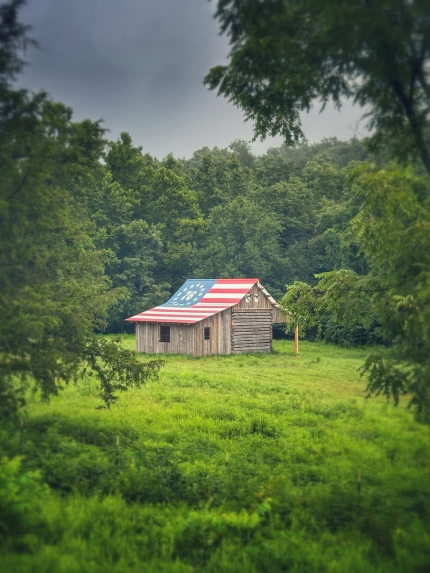
This summer, Gainesville resident Robert Taylor, along with his son Jaxon and family friends Sy Jeckstadt and Ed Zimmer, built a similar cabin to one that stood in the same bottom field when his parents purchased the farm in the 1970s. The men then recreated the vibrant roof design that his parents first commissioned 50 years ago (see below). Times photo/Jessi Dreckman.
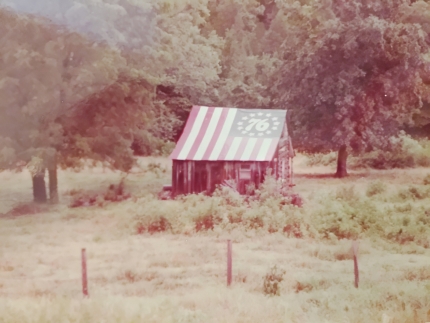
In 1976, in honor of America’s 200th birthday, Lee and Gladys Taylor commissioned this patriotic 13-star design on the roof of a primitive cabin that stood in the bottom field of Pinnacle Ranch off Highway 5, north of Gainesville. The cabin was originally built in the early 1880s by pioneer settlers John and Eliza Lawrence. The old cabin was demolished in the 1980s after it was beyond repair. Times archive photo.
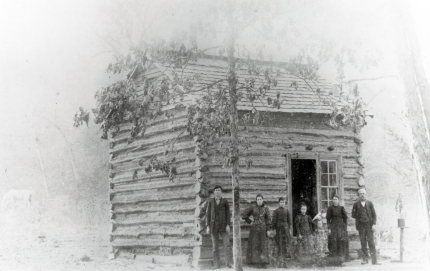
Believe it or not, the three photos below show the same cabin, which stood in a bottom field located along what is now Highway 5, a few miles north of Gainesville. This photo shows the cabin after it was newly built by John and Eliza Lawrence in the early 1880s. The pioneer potter, his wife and children came to Ozark County and homesteaded 160 acres in Gainesville at that time. Times archive photo.
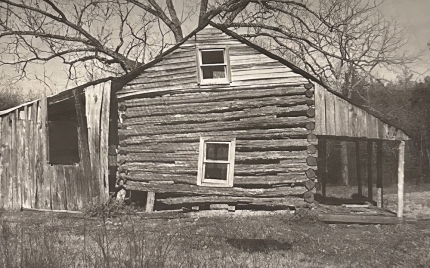
This photo shows the same cabin, which had stood for nearly 100 years at that point, shortly after Lee and Gladys Taylor purchased the farm and cabin from John Lawrence’s grandson, John Cockrum and his wife Madge. As you can see, a lean-to and a front porch were added to the original pioneer structure sometime in the 1900s. Times archive photo.
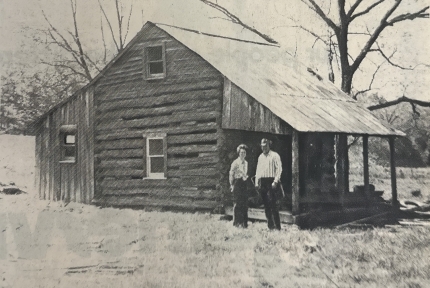
The Taylors took on restoring the old cabin, and Lee and Gladys are pictured in front of the restored structure here that accompanied an April 29, 1976, article. The Taylors later painted the roof of the cabin with a patriotic 13-star flag design. Times archive photo.
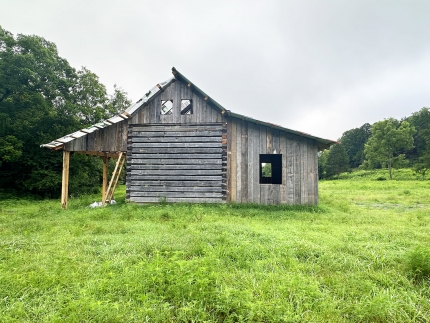
When comparing the side view of the newly built cabin, pictured here, with the older cabin, pictured above, it’s obvious the same layout is being used. Robert Taylor says the new cabin was built larger to be more comfortable for modern living when its finished. Times photo/Jessi Dreckman.
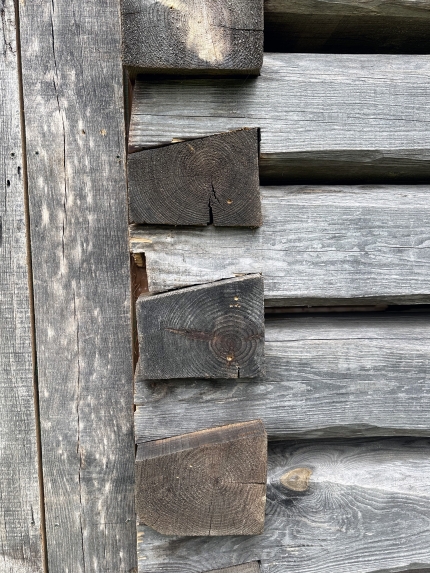
Jaxon Taylor has taken on the very precise job of dovetailing the logs for the cabin. Hand-cutting a dovetail joint is widely considered the ultimate test of a woodworker’s patience, precision and muscle memory. While the interlocking design of pins and tails creates an incredibly strong and beautiful connection, achieving a gap-free fit by hand requires an exacting, multi-step process where a single millimeter of error can ruin the joint. Times photo/Jessi Dreckman.
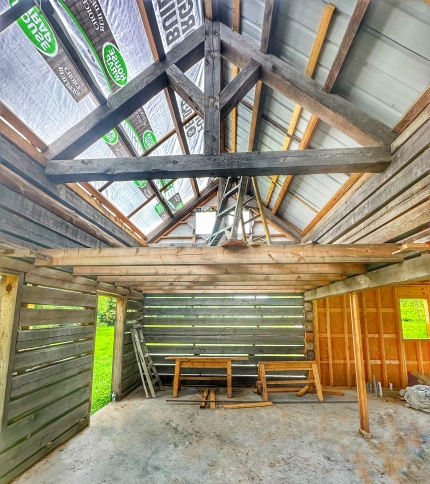
Much thought and craftsmanship is being dedicated to finishing out the interior of the cabin, which will include a loft when complete. The wood used for the cabin was cut, planed and milled at the farm. Times photo/Jessi Dreckman.
More than 140 years ago, a young potter named John DeLoss Lawrence came to Ozark County with little more than a dream of claiming 160 acres and building a home for his family. Alongside his wife, Eliza, he transformed a stretch of wilderness into a homestead, raising their children in a modest two-room log cabin that would stand for nearly a century just north of Gainesville.
Today, that same spirit is being carried by another family, the Taylors, whose newly built cabin stands in the same spot.
A place of gathering
But, back to pioneer times: John Lawrence’s surviving letters to his parents during those 1880s to 1890s years, and later recollections from their daughter Edith, tell the remarkable pioneer story of the Lawrences. Once their homestead was established, its history became less about surviving the frontier and more about the generations who lived there. The pages of the Ozark County Times begin to fill in those years, preserving snapshots of everyday life that transformed a simple log cabin into one of the community’s familiar gathering places.
As the years passed into the turn of the century, newspaper mentions suggest the Lawrence family became deeply woven into the fabric of the community. The Ozark County Times chronicled not only life’s major milestones but also the ordinary moments that painted a picture of everyday life in rural Ozark County.
One report from May 10, 1918, told of an unexpected health scare. “On Saturday evening, John Lawrence… was found by the roadside at the O.T. Sims farm in a dazed condition. He had been in town and had eaten some canned fish, which caused acute indigestion. He was moved to his home, where he received treatment.”
Other brief newspaper items noted John trading in Gainesville in August 1918, cutting a bee tree full of young bees in April 1919, and renewing his Ozark County Times subscription in both 1920 and 1922. Eliza, meanwhile, was reported visiting her son and his family in the Never Fail community in 1930, while another item mentioned that John had been suffering from rheumatism. The small notices may seem insignificant, but together they offer a glimpse of a family living an ordinary life in extraordinary times.
The Lawrence cabin also became a gathering place for friends, neighbors and relatives. With only two modest-sized rooms inside, celebrations often spilled out beneath the shade trees surrounding the little log home. One of the best snapshots of that community spirit came on March 23, 1930, when friends surprised John and Eliza with a community dinner. “At noon,” the newspaper reported, “a delicious dinner was spread in the yard where 33 of us gathered around and helped ourselves. The dinner was wonderful. There was enough to feed 33 more.”
Although the nation was slipping into the hardships of the Great Depression, the anonymous writer couldn’t resist adding a touch of Ozarks humor. “Don’t let us say we are poor in the Ozarks anymore, for when it comes to eats, we have other places beaten.” The article closed by wondering when everyone might enjoy another reunion like it.
Nearly a century later, it’s easy to picture the scene: neighbors visiting beneath the trees, children playing in the yard and tables filled with food prepared by dozens of local families. The little cabin had become much more than a home. It had become part of the community.
The end of one chapter
In 1931, the Lawrences’ daughter Mae returned to spend a week at the family cabin. Seven years later, the family’s story took a sorrowful turn. In 1938, Edith returned home to care for her 83-year-old mother, Eliza, who had become gravely ill. One edition of the Ozark County Times first reported that Edith was caring for her mother. Later in the very same edition, likely after the first item had already been typeset, a second notice announced that Eliza had died Nov. 1, 1938, at the home of her daughter Mae.
John remained at the cabin another few years. But when he died at the age of 87, it brought a close to the lives of that pioneer couple who accomplished their dreams of transforming 160 acres of wilderness in the Ozarks frontier into a family homestead. The dream John first described in letters to his parents had become reality, and the little cabin had witnessed every step of that journey.
Ownership of the property passed to Edith, the second-youngest of the couple’s five children. Whether she and her husband, Lorenzo Cockrum, ever lived in the old cabin is unknown. By then, newer and more comfortable homes were becoming common throughout the county. Eventually, the farm passed to Edith’s son, John Cockrum, who had built and lived in another house on the farm with his wife Madge (Breeding) and their two daughters, Reba and Betty. It was John who sold the property to the current family who has left its own lasting mark on the land.
The Taylor family purchases the farm
That transition came more than three decades after John Lawrence’s death. The little log cabin was still standing, though time had taken its toll. When new Highway 5 was carved through the countryside in the late 1960s, replacing the windy “old Highway 5” and even older “Springfield Road” the pioneers traveled on, the weathered cabin, once hidden among the timber, suddenly came into public view.
In 1975, Leroy and Gladys Taylor purchased the Lawrence farm from John Cockrum, Edith Cockrum’s son and the grandson of John and Eliza Lawrence. Not long afterward, they began restoring the aging cabin with the help of local craftsman Dale Chisam.
Interviewed by the Ozark County Times during the restoration, Chisam imagined the cabin’s beginnings much the same way many pioneer homes were built, with an old-fashioned house-raising.
“That’s the way everybody generally did, help each other in putting up their cabins,” he said, describing what likely would have involved men from several neighboring farms in the surrounding hills coming together to raise walls.
The Taylors worked to preserve as many original features as possible in their restoration process. The cabin’s hand-hewn logs rested on a dry-stacked rock foundation. Even the clay used to rechink the logs came from the same deposit John Lawrence had mined nearly a century earlier to make his pottery.
A tribute to America’s 200th anniversary in 1976
Unfortunately, much of the original hand-riveted oak shingle roof had deteriorated beyond repair. In deciding how to replace it that year, the Taylors took inspiration from the country itself.
America was preparing to celebrate its Bicentennial that year in 1976, so the Taylors commissioned a patriotic mural across one side of the cabin’s roof facing Highway 5. Artist Rene Ornelas, friends of the Taylors from their previous home in El Paso, Texas, assisted by Fred Compos and Tony Ortiz, painted a 13-star Colonial flag with a large “76” at its center.
Over the years, with that little cabin and its patriotic roof situated on their farm, Lee and Gladys continued to raise their family in those Gainesville hills. That is where their four children, Mark, Kellie, David and Robert, grew up. Lee became a well-known real estate broker and owner of Ozark Investments, but he wasn’t shy to let people know that his real passion was owning and operating the Red Angus Pinnacle Ranch in those same bottom fields the Lawrence family homesteaded. He died Dec. 30, 2011, but the legacy of the property continues.
Multiple generations
Like the Lawrences, the Taylors have also had generations of family make that farm home. Gladys still resides on the Pinnacle Ranch property, living in a home set high up on a hill. Her son Robert lives there too for part of the year when he returns home from Alaska, where he has established a successful landscaping business over the last 35 years. He resides in the northern state for seven months out of the year, returning home to the Gainesville farm during the fall and winter months. Robert says he loves coming home.
The next two generations also call the property home. Robert’s son Jaxon and his daughter Leah live full time in the home John and Madge Cockrum built on the property.
One mystery that has never been solved is that of the yellow flowers. “Every year someone left yellow flowers in the window of that cabin, and we never knew who it was or why they did it,” Robert told the Times.
He remembers the old pioneer cabin as a background for many childhood memories. “I remember hunting and trapping off that porch as a boy,” he said. “But eventually, probably 8 or so years after my parents bought it, the cabin rotted and ended up falling in. I remember we tried to fix it up once, but it just got in such bad shape that it became dangerous.”
Eventually, sometime in the mid-80s, the cabin was demolished when it was past the ability to be repaired. And that bottom field sat empty for more than 30 years.
But, like John Lawrence, Robert has found a calling in making art from the bounty nature provides on the farm. Not from the ground like the pioneer settler but instead from the trees. Robert says he’s logged trees off the farm property and used a sawmill he has at his house to make lumber and logs for decades. About 8 or 9 years ago, he took some of that lumber and fashioned a primitive cabin in the yard of the house that Jaxon and Leah live in now.
“I’ve been sawing wood back there for 25 years. I started not knowing a lot, but I’ve gotten pretty good over the years. When I’m home, I work out there every day. I love it back there,” Robert said.
An idea that took hold
This spring, half a century after his dad commissioned the original flag painting on the old pioneer cabin, the Taylors decided to let that piece of history inspire the cabin’s newest chapter. In anticipation of America marking its 250th birthday this summer, Robert’s brother Mark suggested they rebuild the old pioneer cabin and recreate the familiar roof to once again become a canvas for a 13-star flag, this time honoring the nation’s Semiquincentennial while paying tribute to the Taylors’ Bicentennial-era restoration.
“We’ve always kind of thought about doing that,” Robert said, referencing rebuilding the cabin. In need of logs and wood that were dried enough to reconstruct such a cabin, Robert decided to dismantle the primitive cabin in Jaxon’s yard and use the wood for the new project.
Robert and Jaxon enlisted the help of family friends Sy Jeckstadt and Ed Zimmer. “Sy is a master timber framer. He is a very skilled kid who has worked for Bass Pro for 10 years or longer, alongside his uncle, whose worked for them for 45 years. They design all the [Bass Pro] buildings and notch all the logs. Sy has really become a master carpenter over the years. I’ve known him a long time. He was around the same age as my son Jared, and he used to hang around at my saw mill when he was young,” Robert said. “And Ed does a little bit of everything. He’s a brilliant and amazing guy who knows a little about anything you’re trying to do. I couldn’t have done it without either of them.”
Jaxon took on the job of dovetailing the logs to fit at the cabin’s corners. The centuries-old technique is considered one of the highest forms of log craftsmanship, requiring painstaking precision as each log is individually measured, marked and carved so it interlocks perfectly with the next. No nails hold the corners together, only the exactness of the cuts and the weight of the logs themselves. A well-crafted dovetail joint sheds water, resists shifting and can endure for generations, making it both a practical engineering feat and a lasting symbol of traditional Ozarks craftsmanship.
Robert said that the small crew was able to get the skeleton of the cabin erected before he had to leave for Alaska this spring. After he left, Sy, Jaxon and Ed finished getting the roof installed. Robert said he’d really hoped to get the patriotic painting on the new roof before July 4. It came down to the wire, but they were successful in meeting that deadline. The flag was finished on the evening of July 3.
There is still work to be done, but Robert says they are building the cabin to be finished and lived in. The new cabin has been built a little larger than that old pioneer structure. It measures 21 feet by 14 feet with a 12-foot lean-to and spacious porch.
“It’s going to be really nice inside when it’s finished,” Robert said. “It has these big old trusses and heavy purlins in the rafters, and I’ve got enough lumber for the floors, roof and even large slabs for countertops. We’re hoping to make it the neatest little cabin on Earth. It’ll have a 14-by-11-foot loft with about 2 feet of headroom and one bedroom. We decided to leave all the exterior logs their natural gray color, and the bedroom and bathroom will be finished out really nicely.”
A legacy that has come full circle
Today, the cabin is still a work in progress. The interior remains unfinished, but Robert hopes it will eventually become a one-bedroom retreat, possibly offered as a short-term rental so visitors can experience a small piece of Ozark County history for themselves.
More importantly, the project has returned something to the landscape that had been missing for nearly 40 years.
The original Lawrence cabin sheltered a pioneer family, a potter’s workshop, countless community gatherings and generations of memories before time finally claimed it. The replacement standing in Taylor Bottoms isn’t a replica, nor is it meant to be. Instead, it serves as a tribute–to the Lawrence family who first carved out a life there, to Lee and Gladys who preserved its history a half-century ago and to the new generation determined that the story won’t be forgotten.
Today, more than 140 years after a young potter arrived with little more than a dream, a cabin once again stands in Taylor Bottoms. The names have changed, the generations have passed and the logs are new, but the story of that place endures.
Its next chapter is still being written.
Editor’s note: This is the second installment of a two-part series. The first part is published in the July 29 edition. See that article at: https://www.ozarkcountytimes.com/news-local-news/first-two-gainesville-cabins-built-same-spot-143-years-apart-remarkable-story