
The first of two Gainesville cabins built in same spot 143 years apart -- The remarkable story of the pioneer potter who built a life and a cabin in the frontier of Gainesville in the 1880s
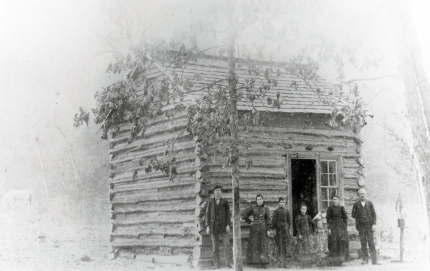
This 1903 photo shows pioneer settlers John DeLoss Lawrence and his wife Eliza (Zimmerman Garfit) Lawrence, far right, in front of the cabin they built on homesteaded land a couple miles north of Gainesville. Five of their seven children are also pictured. They are, from left: Harry DeLoss, Ruth Ellen, Alice May, Edith Mable and Isabel Lawrence. Not pictured are their two other sons, Mose and Frank Garfit, from Eliza’s first marriage and who John raised as his own. They were adults at the time this photo was taken and lived on their own. Mose would have been 29 and Frank would have been 26 in 1903. Family history reports that Eliza’s first husband, Samuel Garfit, set off for California one day to look for better opportunities for his family and was never seen from again.
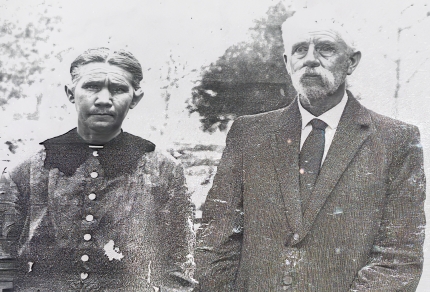
John and Eliza Lawrence
If you've traveled Highway 5 north of Gainesville lately, you may have noticed a new cabin nestled in the fields of Taylor Bottoms on Pinnacle Ranch, just a few miles outside town. Though newly built and still under construction, it doesn't resemble the modern homes of today. Instead, its hand-hewn timbers and weathered gray logs seem to belong to another era.
Earlier this month, the cabin gained an eye-catching finishing touch when a striking 13-star patriotic design was painted across the roof facing Highway 5, completed just in time for America's 250th birthday celebration on July 4.
But the cabin is much more than a roadside landmark.
It represents the latest chapter in a remarkable restoration project that preserves a piece of Ozark County's history. Behind those weathered logs is a story spanning more than 140 years, a story of a pioneer family who carved out a life on that very spot, generations who followed them and a shared determination that their story would not be forgotten.
The pioneers who started it all
To reach the beginning of that story, or at least as much of it as can be pieced together from newspaper archives, family records and other historical breadcrumbs, we have to turn the clock back to Sept. 4, 1855.
That was the day John DeLoss Lawrence was born in Crawford County, Pennsylvania. His future wife, Eliza Zimmerman, followed just five months later, born Jan. 11, 1856, in Indiana.
Little is known about their early lives or how the two met. But, on Aug. 21, 1879, while still in their early twenties, they married.
A family history book donated to the Ozark County Historium notes that it was Eliza's second marriage. She had previously married Samuel Garfit in 1874 and given birth to two sons, Mose and Frank. According to the family history, Garfit, who had been born in Liverpool, England, left Eliza and the boys for California in search of better opportunities for his family and was never heard from again.
John stepped into the role of husband and father, and together he and Eliza began searching for a place where they could build a life of their own.
Letters written to mom and dad
Fortunately for historians, a series of letters John wrote to his parents, Roswell and Rathbun Lawrence and Ruth Ann Terell of Tallmadge, Ohio, survived the passage of time.
Published in the April 1995 edition of The Old Mill Run after being submitted by descendant Clarence E. Grisham, the letters provide a rare firsthand glimpse into what it was like for one young family chasing opportunity on Missouri's frontier.
At the time, John worked as a potter, a trade he had learned years earlier. Before settling in Ozark County, he had practiced pottery in Dade County, Missouri, shaping everyday necessities like churns, crocks, pitchers and storage jars from local clay.
His earliest surviving letter, written Jan. 24, 1882, from Everton in Dade County, is filled with optimism as the family prepared to leave for Gainesville.
"We expect to leave for Gainesville after the first of February. There is an old shop where I can work until I can build my own shop and kiln."
Like many pioneers heading south into the Ozarks, John expected hard work. He likely had no idea just how difficult the journey, and the years that followed, would become.
The Lawrences left Everton on Feb. 13, 1882.
The trip took only a week, but spring rains turned the roads into mud and swollen streams blocked their path. At the time, most Ozark waterways virtually no bridges, making travel nearly impossible during periods of high water.
Writing to his parents on April 1 of that year, John described both the exhausting journey and his first impressions of the rugged country that would become his home.
"We left from Everton on the 13th of February, arrived here on the 20th. Rained most of the time we were on the road, and, as there are no bridges in this country, a person can't get along much in time of high water.
"This is some of the roughest country I have ever seen. Very little of the land is cultivated except for the little narrow hollows, and they are subject to overflow.
"It is a grand country for stock raising, so much of the land is covered with rank growth of wild grass."
Despite the challenges, John's ambitions remained unchanged. He told his parents:
"We are driving away at the little old shop. I intend to keep it going until I can raise a team and wagon, and then I shall hunt me up 160 acres of Uncle Sam's land that has clay on it and homestead it and build some kind of kiln on it, a log cabin and a shop."
His dream reflected the opportunities created by the Homestead Act, a federal law that allowed settlers to claim 160 acres of public land for free by living on it, farming it and improving the ground for at least five years.
Before he could do that, however, John first needed enough money to buy a working team of draft animals (horses, mules or oxen) and a wagon. Those were essential tools for farming, hauling supplies and transporting pottery to customers throughout the Ozarks.
Finding hard times in the remote
frontier of Ozark County
Only a few months later, the excitement of beginning a new life had given way to the harsh realities of frontier living. Writing on June 29, 1882, John described widespread food shortages that had settled over southwest Missouri:
"Missouri is having a pretty rough time of it at present. There isn't anything to eat in this part of the country. I went off with a load of ware last week and went 50 miles west of here and could not get a pound of flour or meal on the whole trip. After I got back, it took me two days to find a bushel of corn to take to the mill and had to pay $1.25 for it."
It's a striking reminder of how isolated Ozark County remained in the early 1880s. Even a craftsman willing to travel 50 miles with wagonloads of pottery sometimes couldn't buy enough flour to feed his family.
By November, John was already looking for better working conditions. The pottery shop where he had been employed since arriving in Gainesville was primitive, even by frontier standards.
"The shop I have been turning in this summer is about twelve feet long and ten feet wide and has no door or window although there is a place for a door.
"Harry Smith and Simms have got their shop pretty near ready to go to work in, so I will go down there. It is a mile and a half from where I am now, and I can't work in this shop."
Potters of that era were often paid according to the amount of finished ware they produced rather than by the hour, making both speed and working conditions important to earning a living.
A move away from Gainesville -
and a joyous return
For reasons that aren't entirely clear, perhaps the difficult conditions or the search for steadier work, the Lawrence family appears to have left Ozark County the following spring for a new home in Webster County.
John's April 10, 1883, letter, written from Garvis Point, shows they were still struggling to get ahead.
"We are all well with the exception of bad colds. I should have answered your letter sooner, but I was getting ready to move, and I thought I would not write until I got moved. I am now back at Mr. Paterson's turning by the gallon. I get 1¾ cents per gallon."
The phrase "turning by the gallon" referred to producing pottery by volume, with pay based on the number of gallons of finished crocks, jars and other vessels completed.
Two months later, John's situation had changed little.
"I took a bottle of Hop Bitters this spring, and it has almost made a new man out of me. I am idle the greater part of the time. Mr. Paterson occasionally gives me a day's work on his farm. He pays me 50 cents, so you know that I am not making much headway towards buying a farm."
Then, at last, the letters begin to reveal a turning point. In November 1883, John wrote once again from Gainesville.
"I have been on the move again. We moved here from Webster County the last week of September. I have a claim on 160 acres of Uncle Sam's land. My claim is adjoining Sam Dinnigan's farm. I am potting with him. One of the main objections to this country is that there are no schools here that amount to much and there is none at all close to me."
After years of uncertainty, John Lawrence had finally accomplished the dream he first described to his parents nearly two years earlier. He had established his homestead in Gainesville.
The 160 acres he proudly wrote about in that letter is the same bottomland where the new cabin now stands more than 140 years later.
His next concern wasn't for himself. It was for his children. With Mose, Frank and Harry reaching school age, John worried about the lack of education available on the frontier.
"My oldest boys are old enough to go to school, and it wouldn't be much longer 'til Harry will be old enough to go and the nearest school to us is four miles away. It is out of the question to send little fellows that far to school, especially through as wild a country as this."
It was the kind of everyday concern shared by countless pioneer parents: building a home was one challenge; raising a family there was another.
A life built on the homestead
By the spring of 1886, the Lawrence family had settled into life on their new homestead. Their little log cabin in what is now known as Taylor Bottoms had become more than simply a place to sleep. It was home and the foundation of the family's future.
That April, John happily shared news of another addition to the household.
"I received a lady boarder in the family on the 13th of this month. Mother and child are doing well. We have decided to call her Alice May."
Five months later, another letter painted a picture of a community that was slowly growing around the once-isolated homestead.
"I now have four neighbors that live not more than half a mile from me. Tell Frank I got the bluing all right and blued the first piece of ware that was ever blued in Ozark County."
The "bluing" John referred to was a blue glaze applied to pottery before firing. The colorful finish was considered a mark of quality and required materials that were not always easy to obtain on the frontier, making his accomplishment a point of pride.
Not every letter, however, carried good news. On Dec. 20, 1886, John mentioned a group that was making headlines throughout southwest Missouri:
"The Bald Knobbers, or the Law and Order League as they are termed, are getting quite active here. They have taken several men out of their home after night and whipped them for small offenses."
The Bald Knobbers were a controversial vigilante movement that originated in the Ozarks during the 1880s. Organized to combat crime in areas where formal law enforcement was scarce, some local chapters eventually became known for taking justice into their own hands, often using intimidation and violence.
A skilled potter by trade
John Lawrence's name first appeared in the local newspaper, the Ozark County News, several years later.
The first time was in the Feb. 12, 1891, edition when he was listed as a witness for fellow Gainesville resident and potter James Dinnigan, the Lawrence family’s neighbor, as Dinnigan completed the final proof required for his own homestead claim.
But John's greatest contribution to early Ozark County was made in clay. Several Ozark County Times articles published decades later describe Lawrence as one of the area's most accomplished pioneer potters.
One of the most fascinating accounts appeared in the April 28, 1960, edition after local farmer Tom Hardcastle uncovered the remains of an old pottery site while plowing a field along Lick Creek north of Gainesville.
As his plow turned the soil, Hardcastle discovered what the newspaper described as a 30-foot-square area "seeded thick" with broken pottery fragments, many coated in a distinctive blue-green glaze. Mixed among the shards were bricks from an old kiln.
Local historian Cal Hogard believed the site had belonged to S. I. Dinnigan, the same potter John mentioned in his letters and whose claim for homestead, which lay adjoining his, he later witnessed.
According to Hogard, Gainesville had been home to several respected potters during the late 1800s, including Lawrence, Dinnigan and Enoch Thompson. Harry Smith, another name mentioned in John's letters, operated what was believed to be the area's only kiln for a time. The 1898 Missouri Gazetteer also listed Smith as a potter in Gainesville.
Hardcastle recalled stories his father had told him about those early pottery operations.
A mule was hitched to a sweep that walked in circles, powering a grinder that crushed clay into a fine powder before it was mixed with water and worked into usable pottery.
Once fired, the finished crocks, churns, jugs and pitchers were loaded onto wagons and hauled across southern Missouri and northern Arkansas to be sold or delivered to customers who had placed orders in advance.
It was demanding work, but it allowed craftsmen like John Lawrence to support their families long before factories brought mass-produced goods to rural America.
A family raised in a little cabin
By 1905, Lawrence himself was making final proof on the homestead he had dreamed about more than two decades earlier. A legal notice published that year observed that he had already lived on and farmed the property far longer than required.
"Mr. Lawrence has been a resident of Ozark County about 23 years and homesteaded several years ago four miles northwest of town on the Springfield Road where his family has resided continually."
The Springfield Road mentioned in the notice was the wagon road pioneers traveled long before today's Highway 5 crossed the same countryside.
Although no record has been found showing exactly when the cabin was built, a photograph taken in 1903 captures John and Eliza standing proudly outside it with five of their children.
The image shows a modest but sturdy home. The 14-by-16-foot log cabin with a wooden door, glass-paned windows and enough room to shelter a growing family.
The best description of the cabin itself comes not from official records, but from the couple's daughter Edith, who inherited the property after her parents' deaths.
More than half a century later, in a 1961 Ozark County Times interview, Edith (then in her mid-70s) looked back on the home where she grew up.
"The cabin is built of stout oak logs and chinked with clay from the area. The windows have glass, and the two-room cabin has a spacious loft reached by well-designed and easy-to-climb stairs. It has a feeling of home and the two rooms seem friendly and comfortable, though the fireplace is no longer there."
Her memories also preserved details of her father's pottery operation that no photograph could capture.
"At the other side of the cabin is a storage cellar skillfully made from bricks burned in [my father’s] kiln," she recalled.
She explained that John gathered clay from nearby Lick Creek before having it crushed into powder by a horse-powered grinder. Water was then added to create "slip," the workable clay used to fashion jars, churns, pitchers and crocks before they were fired in the kiln.
"He did a lot of his work on order and made deliveries as far away as Mountain Home in a rented wagon," she said.
An Ozark County Times item published Sept. 5, 1902, appears to confirm those deliveries, noting that "Jack Lawrence" had passed through Gainesville with a wagonload of pottery bound for Mountain Home, Arkansas.
Whether John was known by the nickname "Jack" or the newspaper simply made an error is impossible to know today. No other potter named Lawrence appears in local records from that period, making it likely the article referred to John.
A child's memories
Edith's favorite memories involved being a little girl growing up in that cabin. She remembered becoming ill one day when Dr. Beach came to the family home to treat her. During the visit, her father crafted a miniature set of dishes and a tiny butter churn for Edith, then made another set for the doctor's daughter. She delighted in pretending to churn butter with the little toy.
"As children," she told the reporter, "we often fashioned clay dishes for our father to burn when he fired the kiln. It took about three days to burn and glaze the pottery."
Those small recollections reveal something the historical record often cannot. To John Lawrence, the cabin wasn't simply a homestead. It was where he worked beside his children, taught them his trade and quietly built a life that would leave its mark on Ozark County long after he was gone.
To be continued...
*****
Editor’s note: This is a two-part feature story on the two families who have owned the land that is now Pinnacle Ranch, located a few miles north of Gainesville, on Highway 5 since the 1880s. Part II will be published in next week’s edition.