
'Million-dollar bridge' at Theodosia was dedicated 70 years ago this month
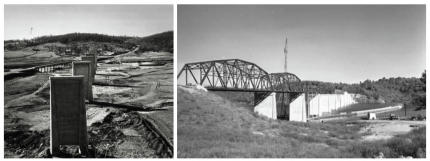
These photos show the construction of the Theodosia Bridge on what is now Highway 160 as it was built over the Little North Fork of the White River in 1952-53. In the photo at left, the newly built piers tower over the old bridge that still spans the river valley. At right, the rising water of Bull Shoals Lake, after the completion of Bull Shoals Dam in Arkansas, has nearly covered the old bridge. The photos are from the collection of Theodosia resident Tinker Langston, who said she doesn't recall how she came to own them. The original source is unknown.

This photo appeared on the front page of the Feb. 15, 1953, edition of the Ozark County Times under the headline, "First Car to Officially Open Theodosia Bridge to Traffic.” The caption said the picture, taken a few days earlier, showed "a view of the procession officially opening the new Theodosia Bridge to traffic" and added that "J. C. Harlin, member of the state highway commission, led the group in the opening ceremonies.” The bridge was dedicated several months later, on Oct. 8-9, 1953. Harlin's granddaughter, Sherrill Harlin Hardcastle, a freshman who played saxophone in the GHS band at the bridge dedication, remembers later getting to drive her granddad's Cadillac to school when she got her driver's license
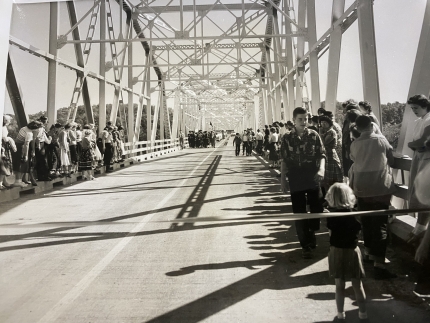
The Gainesville High School band led the procession that crossed the Theodosia Bridge from east to west to start the dedication ceremonies Oct. 9, 1953. School was dismissed that Friday, and what is assumed to be a group of teenagers – many of the girls wearing big skirts with bobby sox and saddle shoes – clung to the steel side rails as the procession neared. When the bridge was built in 1953, the overhead steel braces allowed a clearance of 13 1/2 feet, but as time passed and cargo trucks got taller, that proved to be too low. A MoDOT engineer told the Times in 2015 that every overhead truss on the bridge showed damage where it had been struck. In 2016, a “rehabilitation” project raised the trusses to 15 feet.
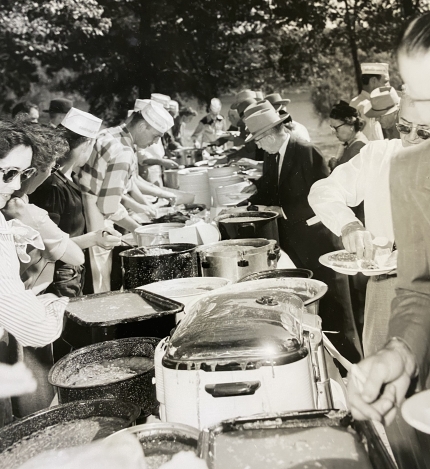
After the bridge-dedication ceremony on Oct. 9, 1953, guests could opt for a $1 barbecue lunch served by the GHS senior class with faculty members' help. Wives of the Lions Club and Chamber of Commerce members had prepared the food, as they had done for an invitation-only dinner the night before. Above, GHS principal and teacher Rex Ebrite, left, in the plaid shirt, joined the students in serving the food, which appears to include several large pots of beans. The photo is from the collection of the late John Harlin, who wrote on the back of the picture that the white-hatted man serving next to Ebrite was GHS senior Delbert Rackley.
Seventy years ago this month, Ozark Countians joined local leaders, government big wigs and Army Corps of Engineers officers to dedicate a massive new highway structure over Bull Shoals Lake at Theodosia, an engineering marvel at the time known as "Southwest Missouri's million-dollar bridge."
The Oct. 8-9, 1953, event was sponsored by the Missouri State Highway Commission, the Ozark County Chamber of Commerce and the Gainesville Lions Club. Activities began at 7 p.m. that Thursday evening with a private "smorgasbord" supper for invited state, local and military officials and other "distinguished guests," according to the Oct. 8 edition of the Times. The meal was "cooked and served by the wives of the Gainesville Lions Club and Chamber of Commerce members," the Times reported.
The Thursday night meal was served at Janian's Holiday Inn, a new hotel that had been adapted from the old, 12-room former home of the Jim Herd family that had stood in the nearby village of "old Theodosia." It had been moved up the hill southwest of its original location by new owner Armand Janian, onto land above what is now the Corps of Engineers Theodosia Campground. The hotel was the only building left of the original Theodosia, a village that had existed for decades a short distance north of the bridge on the west side of the Little North Fork of the White River.
Janian (1912-1980), a colorful Armenian immigrant, had moved from Chicago to Ozark County to take advantage of the tourism he believed would result from the new lake. He had named the relocated hotel "Janian's Holiday Inn," using a name that would later be taken by a national hotel chain. (Later, the building would become the headquarters of developer Gene Wood's Theodosia Hills real estate development corporation. It passed through other owners and uses beginning in 1973 until it was destroyed by fire in February 1981.)
At the Oct. 8, 1953, smorgasbord supper, C. C. Williford, a well-known regional celebrity weatherman on Springfield radio station KWTO, served as master of ceremonies. The official program booklet for the event adds, "entertainment to be provided."
(The booklet and most of the photos accompanying this story are from the late John L. Harlin's collection and were shared with the Times by his wife, Linda.)
The next morning, on Oct. 9, at the west end of the bridge on what was then Highway 80 and is now U.S. Highway 160, Harris Rodgers, chairman of the Missouri Highway Commission, cut a red-and-white symbolic ribbon held up by Ozark County banker J. C. Harlin, also a member of the highway commission. John L. Harlin, J. C. Harlin's grandson, told the Times several years ago that his grandfather’s proudest accomplishment on the highway commission was fighting to get the bridge built across the lake when the commission originally intended to operate a ferry at the site.
J. C. Harlin died Dec. 18, 1955, at age 80, a little more than 14 months after the bridge he fought for was dedicated.
Last days for the old bridge
The new bridge had been under construction for nearly two years as the water gradually rose over the old bridge. In a March 15, 2022, Times story about "old Theodosia," Sue and Estel Robirds recalled crossing the old bridge when the rising lakewater lapped and splashed against its sides – Sue on her schoolbus ride to Gainesville High School and Estel as he and his brother, Dick Stehle, left home to find work in California in March 1952.
"We left at four o'clock in the morning," Estel recalled. Heading west, they "crossed what was left of the bridge," he said. "Water was lapping over the walls. We had to drive through water to get across the bridge, and we barely made it."
Sue's last memories of the old bridge were of the days during her junior year in high school in 1951-52. "I remember the lake coming up and, for a while there, the lake was lapping over both sides of the bridge. The driver would pull up and stop, and we would get out and walk; then he would pull on across."
In the March 20, 1952, edition of the Times, the Center Point correspondent wrote, "Quite a few motored over to Theodosia Sunday evening to cross the old bridge for the last time."
Also in that edition, the Lutie correspondent wrote, "Backwaters are up past Theodosia, and the bridge isn't finished yet. Waiting for steel. Looks as though we are going to have to go a long ways around to get to Gainesville. . . . We are hoping they can soon get back to work on the bridge so No. 80 [highway] will be open."
The new bridge opens
Then, 10 months after those reports, the Times reported in its Jan. 15, 1953, edition, that "the last of the concrete has been placed in the huge million-dollar bridge at Theodosia. . . . The only remaining work on the bridge is the painting of the steel. . . . The contract requires three coats of paint after the steel has been thoroughly cleaned by sandblasting."
One month later, in its Feb. 15, 1953, the Times published a photo of J. C. Harlin and his Cadillac – "the first car to officially open Theodosia Bridge to traffic."
Although the bridge officially opened for traffic in mid-February, the dedication wasn't held until eight months later, in October.
Behind the ribbon that was cut that morning of Oct. 9, 1953, was a procession of cars (including J. C. Harlin in his Cadillac) described in the program booklet as a "Travel Progress Parade" led by the Gainesville High School marching band.
Two of the 14 members in the band, Mary Ruth Luna Sparks and Sherrill Harlin Hardcastle, now in their 80s, both remember that the October day was hot, and the band's "new" uniforms were scratchy. Neither can recall the GHS band director's name at the time (although Sherrill thinks it might have been Raegan or Reagan), but they said he had bought the wool uniforms secondhand from some other school or group, ignoring the fact that the Gainesville school's colors were red and white and the pre-owned uniforms were brown and gold.
Sherrill, who played saxophone and graduated in 1957, would have been a freshman in October 1953. Mary Ruth, who played clarinet and graduated in 1960, was a 10-year-old sixth-grader, 16 days away from turning 11 on Oct. 24. Recognizing that the school year had started barely two months earlier, and most likely any sixth-grade band members would have just started playing an instrument as junior band members, one marvels at the talent (and perhaps courage) the band director had in preparing his musicians to perform for the ceremony.
When the band and procession had made it across the bridge, a symbolic ribbon was cut, and then the ceremony moved to Janian's nearby Holiday Inn hotel, where speeches were made from the porch.
The "dedicatory address" was delivered by Col. Herbert D. Vogel of Dallas, head of the southwestern district of the Army Corps of Engineers. He "predicted a bright future for the recreational area here," according to the Oct. 15, 1953, edition of the Times.
Vogel added, "There is no doubt that the 100,000 people who visited Bull Shoals in 1952 will be multiplied many times over within a decade." Vogel also predicted that "for every dollar invested" in what he called "America's newest vacation land," more than a dollar will be returned within the next 50 years.
The program booklet continued the proud themes of accomplishment and progress proclaimed in the speeches. A caption below a photo of the finished bridge said, "Spanning the beautiful blue, clear waters of the Little North Fork Arm of Bull Shoals Lake stands the gigantic Theodosia Bridge. The one-third-mile-long structure was completed early in 1953, ending a two-year period of construction which experienced many delays of both natural and economic causes. Containing more than 4,000 cubic yards of concrete and approximately 2 1/2 million pounds of steel, the Theodosia Bridge is being dedicated as a monument to the progress of Southwest Missouri and to the future growth and development of the entire Ozarks area."
The booklet also included a photo of Bull Shoals Dam and said it was built "for control of floods and for the development of the water resources of the White River Basin. Construction on the dam was begun in June 1947, and the placing of approximately 2,100,000 cubic yards of concrete in the dam required a period of 4 years and 7 months to complete."
Sixteen area resorts had donated a night of lodging on Oct. 8 to the Lions Club "to aid in financing the dedication ceremonies," the booklet said. It listed the participating resorts as well as the names of six businesses or people who had "made substantial cash donations to aid in the ceremonies."
After the speeches on Oct. 9, a "public barbecue" was held, for a cost of $1 per person. Guests had been asked to make reservations with a committee consisting of Marvin Kirkpatrick, Roy Lister and Howard Wade. Again, the food was prepared by local women. This time the GHS senior class served the buffet-style meal.
'It was quite a day, but also sad'
JoAn Kyle Henningsen, who grew up in Isabella at the general store owned by her parents, Alton and Linnie Kyle, remembers attending the dedication celebration. She was 11 and thinks she was probably in sixth grade in the two-room Isabella school.
JoAn rode to the event with her grandfather, D. W. "Doc" Johnson, who had moved near the Kyle Store with his wife, Ann, after the government condemned his farm ahead of the impoundment of the lake. He adamantly refused the amount of money the government was going to pay him and filed a lawsuit in federal court in Springfield to demand more for his farm. "And he got more," JoAn said. "But by the time he paid the lawyers and everything, it didn't amount to much."
Her grandparents' land was on Spring Creek at the end of what is now HH Highway near Isabella. All of Doc's brothers had land nearby, and all lost their farms to the lake. Their parents' graves had to be moved. So, like many people whose land was taken by the Corps, the Johnsons had bitter feelings about the lake and the changes it brought.
JoAn understood those feelings but still thought the dedication was exciting. "I thought I was grown up, and I was dressed up like a queen that day," she said. "I thought it was wonderful that all these officials were coming down to see the bridge."
She wore a black-and-white-checked dress, made by a local seamstress, and her Sunday shoes – black slippers that "started hurting my feet because I was walking back and forth across the bridge. People were doing that."
Her parents didn't go to the dedication "because the post office was in the store, and my mother was the postmaster," JoAn said, adding also that "it was a big day for the store" because so many people were heading to or coming from the bridge dedication, and Kyle's Store was the only place between the lake and Gainesville where people could buy sandwiches (made out of lunchmeat in the store's meat case), groceries, sundries and gasoline.
Despite his hard feelings about having to give up his land, Doc Johnson wanted to go to the dedication. "He was very sociable," JoAn said. "He was politically inclined, and he wanted to meet the people there."
They went early to make sure they got a good place to park, she said. Her younger brother Jim, then 9, went along too. And that meant more walking for JoAn in her Sunday shoes "because Grandpa was worried that Jim would fall off the bridge, and I had to keep an eye on him," she said.
The concern was heightened because three and a half months before the dedication, a bridge worker from Illinois, Clarence Herbert Hagler, 26, had died when he fell 42 feet into the lake from a bridge scaffold while sandblasting.
Area residents often went to the construction site to watch the bridgework, and JoAn happened to be at the bridge the day of the fatal accident. "They had just pulled the body out of the water when we got there," she said.
JoAn and her husband, Walt, now live next to the store in the house where she was born. Remembering that day 70 years ago when the Theodosia Bridge was dedicated, she said, "It was quite a day, but also sad for so many because so many people lost their homes when the lake came in."
The bridge, 70 years later
Today, the enduring Theodosia Bridge still carries considerable traffic over Bull Shoals Lake on what is now U.S. Highway 160. But the bridge looks a little different than it did 70 years ago. In 2016, it underwent a facelift and rehabilitation when the Missouri Department of Transportation sandblasted off the old silver paint and applied a new coat of brown, the standard color now, MoDOT engineer Audie Pulliam told the Times for a story in its Nov. 2, 2016, edition.
The bridge's overhead trusses were raised 18 inches to increase the bridge's clearance from 13 feet 6 inches to 15 feet. Another MoDOT engineer, Chris Rutledge, told the Times in December 2015 that all of the bridges' original overhead trusses and sway bars "have places where trucks have hit them crossing the bridge." Pullian added, in another story, the change was done to "dramatically reduce crashes involving tall trucks."
In the next step, with modern consideration for the job's environmental impact, the old paint (what was left of it), had to be sandblasted off with special care and equipment so that absolutely no paint particles fell into the lakewater.
Finally, the bridge's decking was repaired.
The improvements were made with the hope that the "million-dollar bridge" will continue to carry traffic efficiently and safely for decades to come.
The cost of the improvements? $5.3 million.