
‘Coop’s Monarch Camp’ Gainesville woman helps support the 5 percent of monarchs that make it to adulthood
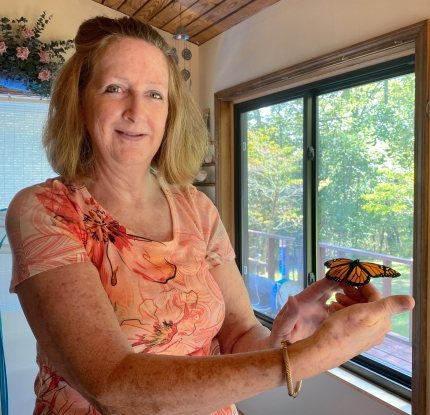
Gainesville resident Carol Cooper is pictured with an adult monarch butterfly that she recently watched grow from an egg to adulthood, a process that takes about 28 days.

1. Carol Cooper snips off the milkweed leaves where a mother monarch butterfly has laid her eggs and brings the leaves inside her home to allow the eggs to hatch without pressure from predators.
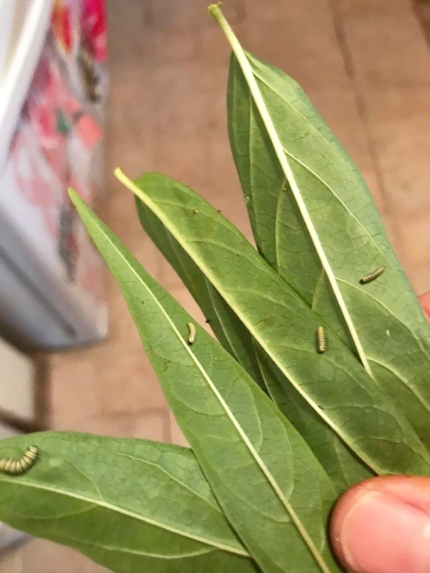
2. After three to five days the eggs hatch into tiny caterpillars, which Cooper has photographed here.
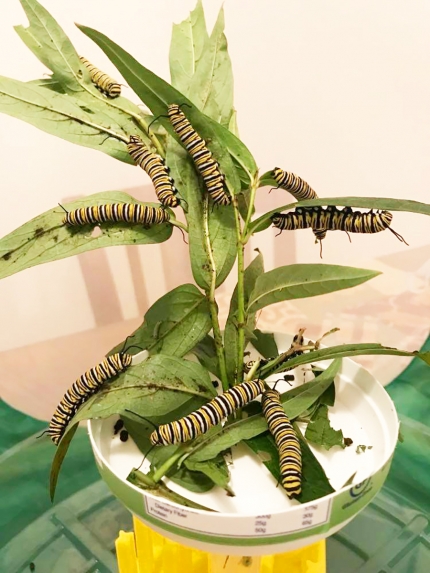
3. With voracious appetites, the monarch caterpillars only eat milkweed leaves. As they grow larger, the caterpillars go through various stages and completely shed their skin five times.
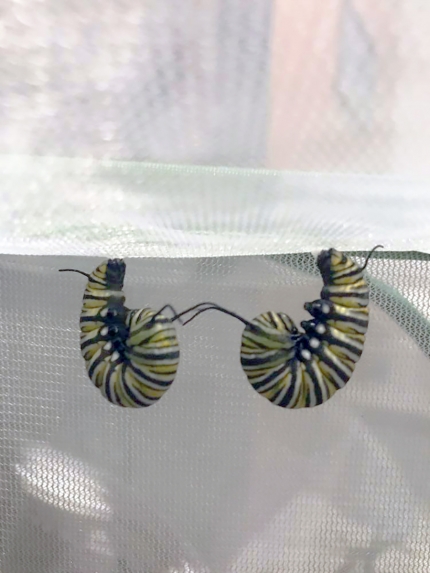
4. After 10 to 12 days of eating, growing and molting, the caterpillars find a place to attach a silk thread and then hang upside down in a J-shaped formation. This pre-pupae state lasts between 12 and 24 hours before the caterpillars pupate and turn inward inside a chrysalis.
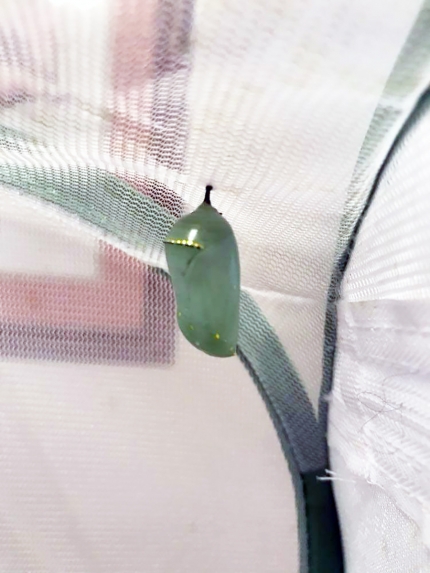
5. The pupae remains inside the chrysalis for 10 to 12 days, where its incredible metamorphosis occurs.
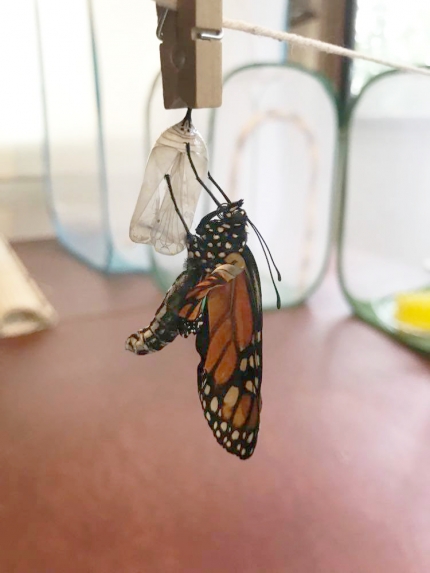
6. As soon as the butterfly emerges, or “ecloses,” from the chrysalis, it hangs upside down and pumps fluid from its body into its wings, causing them to uncurl. As the change occurs, the butterfly evolves into the recognizable form of an adult monarch.
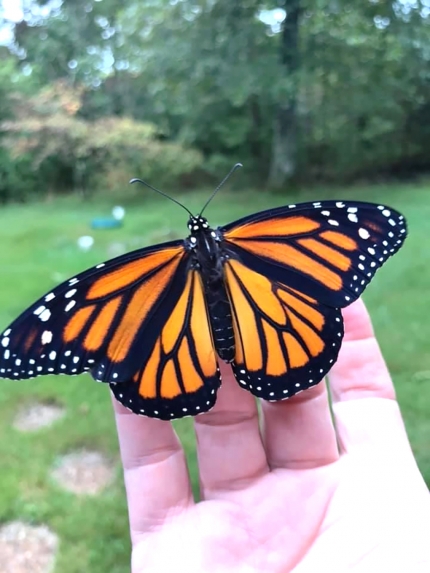
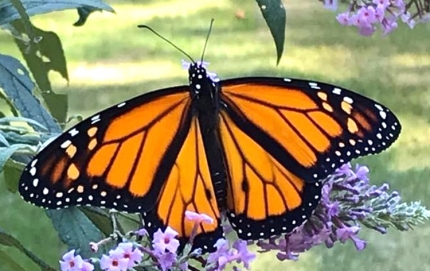
After several hours, the butterflies are ready to be released and begin their new lives, riding the winds in search of nectar. The adult male butterflies, like the one shown below, have two black dots on the “veins” of their lower wings, while the females, shown above, do not.
Gainesville resident Carol Cooper has had quite the busy summer attempting to raise more than 75 monarch butterflies in a bright and airy room she refers to as “Coop’s Monarch Camp.”
In her second year of butterfly rearing, Cooper says 2021 has been an exceptionally difficult one for a number of reasons. But she says that, despite the challenges, she’s dedicated to helping as many monarchs as possible reach adulthood. Experts say that only between 2 and 5 percent of monarchs in the wild make it from the initial egg to adulthood.
A very successful first year
“Last summer was my first summer raising them,” Cooper told the Times. “Both of my kids out in California were raising monarchs, and I was watching their pictures. Their season is a little before ours because it’s warm all the time there. And then my brother, Tom McAndless, who lives near me, started up a bee colony, and he planted milkweed to support the pollinators. Between my kids and Tom, they inspired me. I thought, ‘You know, I’m going to do this too.’”
Cooper took on the venture as a fun project last year with fantastic results.
“Last year was really amazing. Everything went just like it should. At the end of the year, I had released 65 monarchs,” she said. “I was so excited. It was unreal – just really, really wonderful. I was shouting ‘Yay!’ each and every time one took flight.”
In fact, Cooper said that last year’s batch was so healthy and vigorous that she was worried toward the end of the season that she would run out of milkweed to feed them. Monarch caterpillars only eat milkweed leaves, she says, meaning her remaining caterpillars would have starved to death without it.
“I was thinking, ‘I sure hope I have enough milkweed to get me through.’ And it was tight there at the end. My brother was bringing me milkweed from his plants, and I even resorted to posting on Facebook, asking, ‘Does anyone have any milkweed? I’m desperate! I have caterpillars to feed!’” she said.
Her dwindling milkweed supply came from a large bush that she’d planted a couple of years earlier to support the pollinators, before she’d taken a dedicated interest in raising monarchs.
This year she decided to plant a larger patch in addition to her one milkweed bush, ensuring she had enough to successfully feed all the caterpillars she was raising.
A daughter’s visit during the first generation
Last year was so successful that Cooper was eager to dive in with the monarch project this year.
Cooper’s daughter, Nicole Denny, who had raised monarchs in California, came to visit in late July, just around the time the first group of monarchs were fluttering their way into Cooper’s yard.
“We were sitting outside, and we actually watched a monarch lay her eggs. A mother came, and she laid one egg on the underneath of each leaf that she thought was good,” Cooper said. “It was amazing to watch.”
Cooper and her daughter were quick to sweep in after the mother butterfly left the yard, snipping off the leaves and bringing them inside to help deter the many fatal predators that prey on monarch eggs.
“There are garden creatures just waiting to eat the eggs, or birds will pick the caterpillars off like crazy. Then there are insects that actually inject their eggs into the caterpillars,” she said.
The women brought the leaves inside and put them in a small container where the eggs could hatch peacefully without the threat of nature’s predators. The eggs hatched in three to five days, releasing “itty-bitty caterpillars” into the container.
The caterpillars immediately begin munching on the milkweed leaves, growing larger and shedding their skin as they grew into bigger caterpillars. The monarch caterpillars molt their skin five times during that process.
“After they get through the third stage of shedding, I move them over to a tent enclosure, and they stay in there, where they eat and eat and eat and eat,” Cooper said. “Then, when they’re big enough, they stop eating and start rooting around and looking for a good spot [to pupate].”
Cooper says once the caterpillars have chosen a spot, they use their mouth to release a silk web onto the underside of a leaf or other structure and attach the rear of their body to it, hanging upside down in the shape of the letter J.
“Then they pupate. This is the most bizarre thing. They break their skin open and completely shed it, and there’s this green layer underneath.”
The green layer Cooper refers to is the monarch’s pupae state, which takes about three minutes to complete and several hours to harden into a chrysalis. They stay inside the chrysalis 10 to 12 days, completing the internal process of changing from caterpillar to butterfly.
“Then they ‘eclose,’ which basically just means they come out of the chrysalis,” Cooper said. “This is an amazing thing to witness because when they emerge, their wings are all crumpled up from being in the chrysalis.”
The newly emerged monarch is very short and plump due to its compaction within the tiny chrysalis, but within a few minutes the fluid and blood inside the butterfly’s body is pumped out to the wings, and the monarch evolves into its adult form.
The five generations of monarchs per year
The monarch migration has five generations of butterflies that hatch each year, Cooper said. The first four generations usually live only two to four weeks. The fifth generation, the “migrating” generation, lives eight months.
The first generation of monarchs comprise the offspring of the butterflies that overwintered the previous year in Mexico. They emerge from their eggs in April or May. Then they mate and lay their own eggs, giving life to the second generation of monarchs.
The second generation emerges a couple of weeks later, from late April through June, usually in the southern United States. That batch continues the migration path northward, laying eggs in the central United States as they go.
The third and fourth generation of monarchs are the great- and great-great-grandchildren of the overwintering monarchs of the previous year. The third generation emerges in late May through July, and the fourth and fifth generations usually emerge in late June through August.
Online sources say that some fourth- and fifth-generation monarchs are the “migrating generation,” and they go into reproductive diapause, meaning they do not reproduce right after they emerge. Instead, their reproductive organs remain in an immature state, and instead of mating and laying eggs, they spend their time drinking nectar and clustering together in nighttime roosts in preparation for the long journey to migrate back to Mexico.
The migration southward occurs during September, October and early November when the butterflies fly to central Mexico to overwinter. Most of the monarchs continue to have immature reproductive organs until the following spring, when they begin to mate in the overwintering colonies.
‘Monarch black death’
In late July, Cooper and her daughter Nicole were able to bring in 52 eggs, which were laid by the fourth generation of monarchs this year.
“I thought it was going to go really well,” Cooper said. “They were all doing great, just wonderful in the beginning. They were eating, eating, eating… munching, munching, munching. I mean, they were looking good…then the next morning, all of them were lying on the bottom of the enclosure – not dead, but just curled up and sick-looking. I lost all of those caterpillars but two.”
Cooper quickly went to her computer and began discussing the situation with a group of online monarch enthusiasts and specialists who diagnosed the butterflies with “monarch black death,” a fatal disease.
Only two butterflies survived the “black death” episode. Cooper took them onto her porch and released them to the sky, heartbroken for the death of so many other monarchs but happy for the two that made it to adulthood.
Sad but determined
She didn’t let the setback deter her from continuing her work on behalf of the Monarchs, and in the middle of August, another generation of monarchs came through the yard, laying their eggs.
Cooper says each butterfly lays about 12 to 15 eggs a day on the bushes. Altogether she brought 76 eggs inside the house to help protect and raise them during the cycle to adulthood. She’s been able to release 12 butterflies total so far this year, a sad comparison to last year’s 65 monarchs.
Her last batch of chrysalises is now hanging in her home, but several of those have started to form dark spots and other indicators of poor health.
“One thing I’ve battled this year is T-flies,” Cooper said, referring to tachinid flies, a parasite that lays its eggs on caterpillars. The eggs hatch into larva that enter the caterpillar and eat it from the inside out. “There are just so many things that go against monarchs,” she said.
She’s hopeful that there may be a few more bright orange butterflies to release from the fourth generation before the weather turns colder.
‘A miracle - truly’
Cooper has been posting photos of her butterfly venture on her Facebook page, and many local friends and neighbors have taken an interest in her project.
“People are fascinated. They have no idea. Who would know? I mean, when most of us see a monarch, we think, ‘Oh, that’s pretty!’ and then we go on about our day. You just don’t know or think of all the things that have to go right to have a monarch make it to maturity,” she said.
Many followers have thanked Cooper for posting the photos and helping to educate them about the monarch’s life cycle and declining population. She hopes she’s bringing awareness and inspiration to others who will also help the pollinator populations.
“The pollinators are in a bad place now. And if we lose the pollinators, it could jeopardize our future food source. That’s a big deal. So helping butterflies, hummingbirds, bees – all of them – is in our best interests too,” she said.
Area residents are encouraged to join Cooper in helping the monarchs by planting milkweed (Cooper likes swamp milkweed). Call Cooper next April at 417-559-0373 and leave a message, and she will be happy to provide milkweed plants, ready for planting, to those who are interested. She adds that flowering plants, like colorful zinnias, help other pollinators as well.