
Ozark County mother-daughter duo preserves and shares Ozarks history
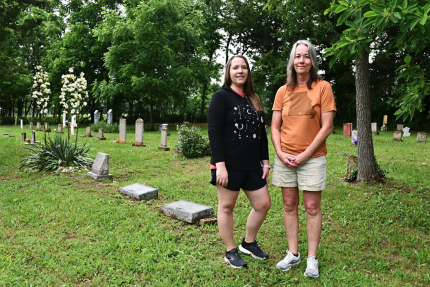
Jessica Leroy and her mother, Mary Collins, work to preserve Ozarks history through two social media entities. Leroy runs Headstone History, dedicated to stories in local cemeteries, and Collins runs Dora Historian Ozarks.
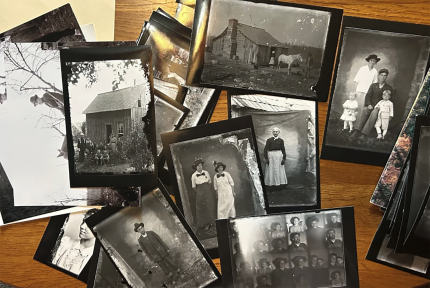
Collins was gifted a collection of glass negatives believed to contain images of Ozark Countians that were taken by photographer Ben Davidson. Here are just a few of the images they contain.
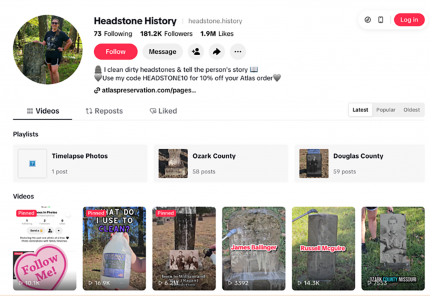
Headstone History’s biggest presence is on TikTok, where Leroy shares videos related to graves she cleans. She also has a Facebook page.

A post Collins made in January 2026 focused on the ghost town of Hammond, Missouri.
Jessica Leroy and her mother, Mary Collins, work to preserve Ozarks history through two social media entities. Leroy runs Headstone History, dedicated to stories in local cemeteries, and Collins runs Dora Historian Ozarks.
Sharing shared history means something special to Mary Collins and Jessica Leroy, a mother-and-daughter duo who use new technology to educate folks, from right down the road and from far away, about the old Ozarks.
Collins, a retired school librarian, primarily uses Facebook as the Dora Historian to post photos and information related to south-central Missouri. Her daughter, under the moniker Headstone History, focuses on the stories found in local cemeteries, amassing a whopping 181,200 followers on TikTok.
While there is some revenue that comes from that sizable TikTok following, the work Collins and Leroy do is largely led by passion and personal connections.
“Family members have found each other on my page, and then there's been people say, ‘Oh, this is my great-grandma, I had no idea,’ because they never looked them up,” Leroy says. “Hopefully I’m helping get some other people interested in history.”
How the History Began
Their own story, in a way, goes back to the 1970s when Collins’s parents moved to the Ozarks with a group of back-to-landers. Originally, they settled near Cabool, but later relocated to the Dora area in rural Ozark County. That’s where Collins went to school and later served as the small district’s school librarian for more than 20 years.
Collins’s interest in history was already growing in this era. Her daughter knows it firsthand: As a child, Leroy often accompanied her mother to cemeteries and country spots with metal detectors. “We’d dig for treasures," she says.
Fast forward to recent years: New technology opened up opportunities to share stories in new ways.
Collins was still working at the Dora district when she had the idea to start posting historical school photos on Facebook. The only problem: The kids weren’t on Facebook. Instead, it was older community members who shared an interest in these images. So she kept posting. After retirement, those efforts expanded to integrating collections of local historical images, like the Toney Aid Collection held at the Ozarks Heritage Research Center in West Plains.
A post Collins made in January 2026 focused on the ghost town of Hammond, Missouri.
“I like it when I find a picture of a town, a small town around here, that I've not seen before,” Collins says.
Historical images sometimes lead Collins to on-the-ground road trips to the places in their current state, like Hammond and Longrun, ghost towns in rural Ozark County.
"We were dismayed to see the decline of the old mill building," Collins posted on her Facebook page. "The roof is caving in at the back. The bank building is being restored and looks great. Hammond post office was established in 1894 and closed in 1975. The mill was built in 1907 by John Grudier. At one time the thriving town had a bank, blacksmith, stores, canning factory, distillery, and churches."
On many posts, including those "modern" ones, there’s often discussion among followers, answering questions she poses about their experiences, or extra thoughts on their own history.
“I think to keep a hold of the past and be aware of who their relatives are,” Collins says, describing her and Leroy’s work as closing an awareness gap. “It's making your genealogy and your family history more accessible.”
The technology that made things possible
That's true for Leroy, too, who has been cleaning graves for years. The former nurse took the hobby after contributing to Find a Grave, a website that integrates “crowdsourcing” in documenting cemeteries.
"In my free time I would go to cemeteries to fulfill photo requests, and find graves that weren't documented yet,” she tells me. Part of this grew out of researching her husband’s genealogy.
“We didn't know anything about my husband's Leroy side of the family,” she notes. “His great-great-grandfather died very young, in a battle in France during WWI. His great-grandfather was a baby when this happened, and he was raised by his mom and step-father. When my husband would ask his great-grandma about the Leroys, she wouldn't answer questions and told him they weren't around anymore. So of course, I started researching and filling in his family tree. I found out they homesteaded not far from where we live, and most of them were buried in a cemetery not far from our house.
“A few years later I was scrolling on social media and I came across another content creator, named Lady Taphos, who was cleaning graves and filming herself. I thought what she was doing was so neat, and then it clicked in my head: ‘Why don't I try this?’ We have so much unique and interesting history here in the Ozarks, and I wanted to share it.”
And now, so many followers later, here we are. She also has a Facebook page, but it “only” has about 47,000 followers.
"Along with grave-cleaning videos, I also post family timeline videos," Leroy notes. "They are timelapse videos of old family photos that show how long everyone in the family lived, and what year the last family member died. These videos are very popular on my Facebook page, and also helped with my page growth this year."
At the end of the day, the preservation work Collins and Leroy do is made possible by modern technology. Virtual tools give more people the power to share and access information than has ever been possible, especially since it doesn't require the same costs traditional publishing has carried
Yet it opens up new questions, like the role of artificial intelligence in "improving" images, and whether connections made online translate to real impact in people's behavior.
I'm told that there's hope that this information will lead to lasting change, whether it's through greater interest in history or those aforementioned family discoveries. It’s at least true for Leroy, who now serves as a board member at the rural Parsons Cemetery.
And even if that content doesn't convince anyone else to take meaningful action, it does give life to those who are gone.
An example comes through crossover between the women's work, like when Collins received a bunch of photos made from glass negatives that were rescued decades ago from a local farm.
Believed to be the work of photographer Benjamin Davidson, the images seemingly showcase locals around Ozark County. Leroy ended up researching Davidson's story, who she learned worked for the railroad for years and whose life is marked by a simple granite stone.
"That's another cool part of my deal," she says, noting that so many people's lives are marked with modest stones that decry their notable lives. "You research the person there, and it's like 'Wow, they have such a cool story, and all this information.'"
"Everybody has something," her mother adds.
Want to learn more?
Connect with Dora Historian Ozarks on Facebook or Headstone History on TikTok or Facebook.