
Local recovery program benefits from county’s portion of Opioid Fund
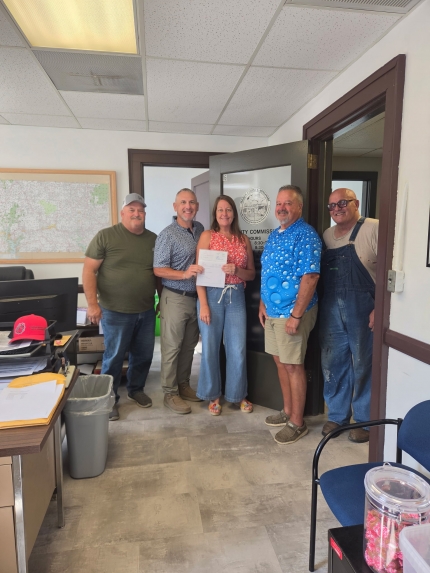
Ozark County Commissioners recently awarded $35,000 from the county’s Opioid Settlement Fund to Action Recovery Center in Gainesville. Pictured, fromt left, is Western District Commissioner Layne Nance, Eastern District Commissioner Jim Britt, ARC Administrator Amber McGinnis, Presiding Commissioner Terry Newton and President of the Ozark County Substance Abuse Task Force Jeff Dotson.
Like so many communities, Ozark County has its share of drug problems and addicts, who actively look for an answer and a way out of their addictions.
Enter the Action Recovery Center, a non-profit program and facility that operates under the Ozark County Substance Abuse Task Force. The program has been operational for less than three years and already has several successful graduates.
But no recovery program is cheap to operate and that is where the latest blessing comes into play.
In 2020, the Missouri Opioid Addiction Treatment and Recovery Fund was established, funded entirely from legal settlement payouts from lawsuits in several states against pharmaceutical companies, drug manufacturers, wholesalers and retail pharmacy chains.
Missouri divides its opioid settlement funding under a 70/30 split between state and local governments. The money can only be spent for certain programs or facilities and funds are periodically deposited to the counties with no established amounts.
Locally, the Action Recovery Center (ARC) in Gainesville was the recent beneficiary of Ozark County’s portion and the program was awarded a $35,000 check.
ARC administrator Amber McGinnis is excited about what the influx of money will mean for the program and facility, which has been open for more than two years now.
“We are succeeding, still learning and wishing to expand,” wrote McGinnis in her presentation to the commissioners. “Our program is working for Ozark County residents and bordering counties in helping them gain and maintain their sobriety, gain employment, reintegrate into the community, become law abiding citizens and regain relationships with their families.”
McGinnis says money from the opioid fund will be funneled through the Ozark County Substance Abuse Task Force and will be distributed as needed.
ARC, which currently is comprised of an eight-bed men’s facility south of Gainesville, has the goal of expanding to a 16-bed facility “to accomodate the need in Ozark County and bordering counties,” says McGinnis. But, in order to expand, ARC needs eight more beds, refrigeration space and furnishings.
McGinnis says the funds will also be used for several other items including a camera system, an attendance recording system with a breathalizer.
Also needed is more money for transportation. “We currently provide transportation for clients to and from work, court and probation commitments, doctor appointments, church, recovery meetings [and more],” says McGinnis. ARC’s current transportation budget is around $1,600 per month but will increase as clients increase.
ARC would also like to offer a “scholarship” to help with attorney fees for clients working toward regaining driving privileges.
A counselor comes to ARC weekly to provide services. McGinnis says the cost is $278 per month, but they would like to increase that amount in order to cover more services and mileage.
McGinnis says ARC also works with the foster system to allow children to visit with their fathers who are enrolled in the program, even staying overnight on weekends.
“Current clients are all employed in Ozark County,” says McGinnis. “They are attending three recovery meetings per week, going to church and maintaining their sobriety and keeping all court and probationary commitments.
“We have eight clients and one house manager. We are getting two new clients this week,” she says. “The are all taxpaying citizens of Ozark County and have become assets to the community.”
In her presentation, McGinnis gave several examples of current clients, their jobs and plans when they graduate.
One client, an Ozark County native, is working as a Certified Nursing Assistant at Gainesville Health Care Center and is pursuing a nursing degree through Arkansas State University in Mountain Home, Arkansas. He has paid all his restitution and has a housing plan when he graduates.
She also shared several success stories including a graduate who has bought a house in Gainesville and offers weekly recovery meetings to the public.
Another former client works in Mountain Home, and has a new wife and two babies. Another graduate works and takes care of his aging grandfather, and another works and takes care of his aging mother.
One graduate lives in Gainesville, is purchasing his first home, and has gained custody of his 10-year-old son.
McGinnis says she hopes the additional money from the opioid fund will continue helping others to maintain their sobriety.